Your guide to opening a commercial register in Saudi Arabia for non-Saudis, Learn the legal conditions, steps, costs, and MISA licensing with SBBS experts.
Knowing how to open a commercial register in Saudi Arabia for non-Saudis is the most prominent question with the increasing influx of foreign investors into the Saudi market, driven by Vision 2030, However, this ambitious desire often clashes withibility of where to start.
The complexity lies not in the procedures themselves, but in the multiplicity of entities like the Ministries of Investment and Commerce, Many make the common mistake of relying on a visit visa or applying for the register before completing investment registration, leading to rejections and delays.
Despite this, the path has become entirely digital and clear when following the correct sequence of steps, With specialized teams capable of paving the way on your behalf, starting is easier; let us explore the secure regulatory path to begin your investment journey.

How to open a commercial register in Saudi Arabia for non-Saudis
For those seeking the exact mechanism of how to open a commercial register in Saudi Arabia for non-Saudis, the process requires a path that precedes actual incorporation, Therefore, the following sections will cover the eligibility to establish, the confusion between licenses, and the total steps to start.
Yes, a foreign investor can obtain a commercial register, but the fundamental prerequisite is obtaining investment registration from the Ministry of Investment (MISA) first.
Afterward, the unified register is issued exclusively through the "Saudi Business Center" platform in three main stages: investment registration, electronic incorporation, and automated linkage.
Does a non-Saudi have the right to open a commercial register?
The current investment environment in the Kingdom is designed to attract foreign talent and capital, Therefore, the legislative system allows foreigners to practice commercial activities and establish entities with high flexibility, provided they adhere to regulatory frameworks.
Procedures are no longer limited to old partnership models, It is now possible to fully own projects in many vital and commercial sectors, aiming to support the growth of the local economy.
All it takes is compliance with the regulations set by the competent authorities and providing the necessary documents to ensure a safe and reliable entry into the Saudi market.
The Difference Between Investment Registration and a Commercial Register (Common Confusion)
Concepts sometimes overlap when starting procedures, especially between investment approval and the actual establishment of the commercial entity, The investment registration can simply be compared to the official entry ticket to the market.
Meanwhile, the commercial register represents the legal identity that allows the company to conduct its daily activities, open bank accounts, and conclude contracts, To clarify this deeper, consider this simplified breakdown:
|
Comparison Point |
Investment Registration (MISA) |
Unified Commercial Register |
|
Competent Authority |
Ministry of Investment |
Saudi Business Center |
|
Document Nature |
Initial approval to invest foreign capital |
Incorporation document of the legal entity |
|
Issuance Priority |
Extracted first (as a prerequisite) |
Extracted second (based on registration) |
Number of Steps and Estimated Completion Time
The procedural path currently features full digitization, significantly reducing waiting periods compared to previous years, The workflow can be summarized in specific points:
-
First Stage: Extracting the MISA registration, a process that takes a few days when documents are pre-prepared and authenticated.
-
Second Stage: Issuing the commercial register via the Business Platform, usually done immediately after drafting and notarizing the articles of association.
-
Third Stage: Automatic linkage with other state institutions, such as the Zakat, Tax and Customs Authority, to open operational files.
To ensure bypassing these details and extracting the register effortlessly, relying on the expertise of the SBBS team professionally shortens this path for foreign investors.

Legal Conditions for Opening a Commercial Register for a Foreigner in Saudi Arabia
Before embarking on executive steps and understanding how to open a commercial register in Saudi Arabia for non-Saudis, it is necessary to recognize the mandatory regulatory requirements, including licenses, visas, ownership rules, and supporting documents detailed in the following subsections.
Ministry of Investment (MISA) Registration as a Mandatory Starting Point
No foreign entity can be established without first obtaining the approval of the Ministry of Investment, This registration represents the cornerstone upon which all subsequent procedures in other government agencies are built.
Through this procedure, the Ministry evaluates the project's feasibility and its alignment with economic goals, Once registration is issued, the road is paved to proceed towards commercial entities.
Residency or Investment Visa Requirement
The legal status of the investor's presence plays a pivotal role in the acceptance of the incorporation, Practicing any commercial activity continuously requires a regulatory cover that goes beyond short-term or tourist visit visas.
Therefore, extracting a valid residency or a dedicated investment visa that grants its holder the right to manage business is required, ensuring the stability of commercial entities and their compliance with labor laws.
Minimum Capital According to the Activity
Financial requirements differ radically depending on the targeted sector, Some consulting and service activities enjoy very flexible financial requirements to encourage talent and knowledge transfer.
Conversely, major industrial or commercial sectors require a higher minimum capital to ensure the operational capacity and financial commitment of the new company in the market.
The Saudi Partner Requirement vs 100% Full Ownership Cases
The regulatory environment has witnessed flexible development, providing wide options in ownership structures, Many vital sectors now allow foreigners 100% full ownership of the project without any local partnership.
However, certain sectors still require the presence of a Saudi partner with varying shares, This difference depends entirely on the nature of the chosen commercial activity.
Permitted and Prohibited Activities (The Negative List)
The market is open to a wide range of businesses, but controls regulate certain sectors, There is a specific list known as the "Negative List" comprising activities restricted exclusively to citizens.
Excluding this list, all industrial, technical, and service fields are open to foreign investment, which supports competitiveness and provides a fertile environment for business growth.
Basic Required Documents
Transforming an investment desire into an official entity requires a precise documentation file authenticated by competent authorities, The core requirements include:
-
An official extract or articles of incorporation of the parent company from its home country, duly attested.
-
A resolution from the parent company approving participation, establishing the new entity/branch, and appointing a manager.
-
Passports and official identities of authorized representatives and ultimate beneficial owners.
-
A summarized business plan for the intended commercial activity and proof of a physical/official headquarters.
Preparing these files and verifying eligibility requires extreme legal precision, which the SBBS team guarantees by preparing the complete file and directly avoiding any procedural complications.
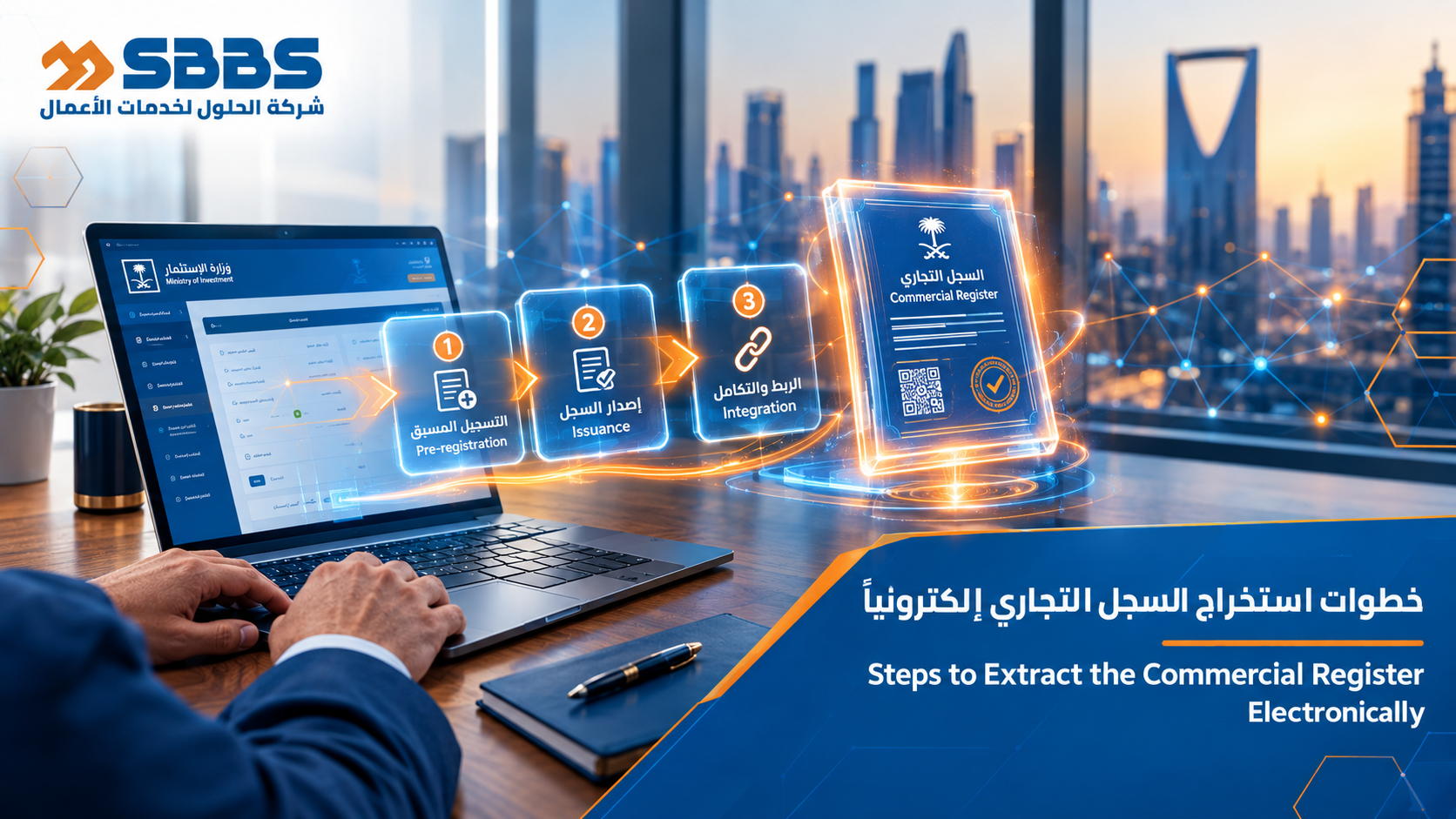
Steps to Extract the Commercial Register Electronically
To understand how to execute procedures practically step-by-step through the correct digital pathway, the following subsections outline login mechanisms, activity authentication, and unified register issuance via the official accredited platform.
Accessing the Business Platform via National Single Sign-On
The official portal for completing these procedures is the "Saudi Business Center" platform, Paper transactions have been eliminated to ensure speed and reliability, moving far away from traditional methods.
The login process is highly secure through the "National Single Sign-On" (Nafath) system, ensuring immediate recognition of the investor's identity and linking their data to approved government records.
Filling out Activity Data and Reserving the Commercial Name
The next step requires defining the commercial activity very clearly, This selection must strictly match the authorities granted in the previously obtained investment registration.
After that, a unique commercial name is proposed for the entity, The system conducts an automated check to ensure the name is not duplicated, protecting intellectual property rights in the market.
Uploading Required Documents and Approvals
The digital system provides space to attach all supporting papers easily, Articles of association, parent company documents, and approvals from concerned authorities are uploaded in clear, readable digital formats.
The quality and completeness of these documents accelerate the review process, Conversely, any deficiency at this stage may lead to application rejection and delay the incorporation timeline.
Paying the Fees (Unified Register + Chamber of Commerce)
After passing the auditing stage, the system issues a consolidated invoice covering the costs of issuing the unified commercial register under modern regulations.
Chamber of Commerce subscription fees are also integrated into the same invoice, The commercial entity is activated immediately upon paying these fees through available electronic payment channels.
Issuing the Register and Automatic Registration with Related Entities
Once payment is complete, the unified digital commercial register document is issued and becomes effective, covering all company activities, The most important feature here is the immediate integration with other sectors.
Facility files are automatically opened with the Zakat, Tax and Customs Authority, and Social Insurance, saving significant subsequent operational time and effort.
To ensure the smoothness of these steps, the SBBS team accomplishes this entire technical path directly on behalf of the client, eliminating the need for exhausting daily follow-ups.

Cost of Opening a Commercial Register for a Foreign Investor and Key Challenges
To understand potential financial burdens and operational roadblocks, this section details costs under modern regulatory updates and key challenges outlined in the following subsections.
Basic Government Fees (Unified Register + Chamber of Commerce + Investment Registration)
The first aspect of expenses is the official approved fees, These obligations begin with the cost of issuing the investment registration with the Ministry of Investment under modern regulatory structures.
Next come the commercial register issuance fees, which are subject to Ministry of Commerce guidelines and periodic review, plus Chamber of Commerce fees determined by activity type.
Indirect Costs (Certified Translation, Notarization, Bank Account Opening)
Government fees are not the only financial burden, Preparing documents arriving from abroad requires certified legal translation and official authentications from embassies and competent authorities.
Costs associated with consultations to organize contracts, notarization procedures, and preparing requirements for opening a commercial bank account also emerge, ensuring a stable cash flow for the company.
Major Challenges Delaying Investors (Trade Name Rejection, Missing Documents, Visa Confusion)
The digital path is fast but requires extreme precision to avoid rejection, Among the most prominent issues facing investors is the rejection ofซิ the trade name due to similarity with existing brands.
Likewise, a missing original parent company document or translation error leads to returning the transaction, Add to this the common confusion between a non-operational visit visa and the required investment visa.
To avoid these hidden costs and wasted time facing procedural challenges, SBBS helps overcome these obstacles by managing the entire incorporation file directly.
How Does SBBS Help You Open Your Commercial Register in Saudi Arabia Without Complexity?
The incorporation path requires precision that goes beyond merely submitting papers; here, the role of professional intervention emerges to organize your investment journey and protect it from delays.
The "Company Formation for Investors" service at SBBS offers a comprehensive solution that manages this entire file, The focus is on overcoming common obstacles by:
-
Extracting Ministry of Investment (MISA) approvals with precision and full compliance.
-
Legally addressing the overlap between commercial and investment visa types.
-
Protecting the budget from hidden costs and transaction rejections due to documents.
This approach is based on institutional experience spanning over 15 years and a reliable regional reach, resulting in serving more than 500 clients.
To expand on these features, you can review the comprehensive guide on ExtractingtheMinistryofInvestmentMISALicense, or learn about the conditions for Establishing a Company in Saudi Arabia with 100\% Ownership.
Time is the most valuable investment resource, Take the initiative to communicate directly to request a consultation in thCompanyFormationforInvestors service and launch into the Saudi market with complete confidence.
Frequently Asked Questions About the Commercial Register for Non-Saudis
-
Can a commercial register be extracted for a foreigner with a visit visa? No, a valid residency or operational investment visa is strictly required.
-
Can a foreigner own 100% of the company without a Saudi partner? Yes, in most vital sectors according to regulations.
-
What is the difference between resident and non-resident procedures? A resident's iqama speeds up incorporation, while a non-resident requires an investment visa.
-
How much are the commercial register fees for a foreign investor? Determined and periodically reviewed officially by the Ministry of Commerce via the Business Platform.
-
How long does it take after obtaining the investment license? A few business days via the unified digital platform.
-
Can a commercial register be opened without a physical store (remote activity)? Yes, exclusively for approved technical and consulting activities.
Conclusion
How to open a commercial register in Saudi Arabia for non-Saudis follows a path starting with investment registration, followed by the unified commercial register, then automated registration.
The opportunity is now favorable in a promising market supported by Vision 2030, and you can overcome every complexity with ease.
Contact SBBS experts today to request the company formation service for investors and launch confidently toward your success.