Avoid the 7 common mistakes in a feasibility study that drain capital. Learn how to validate market demand, cash flows, and break-even points.
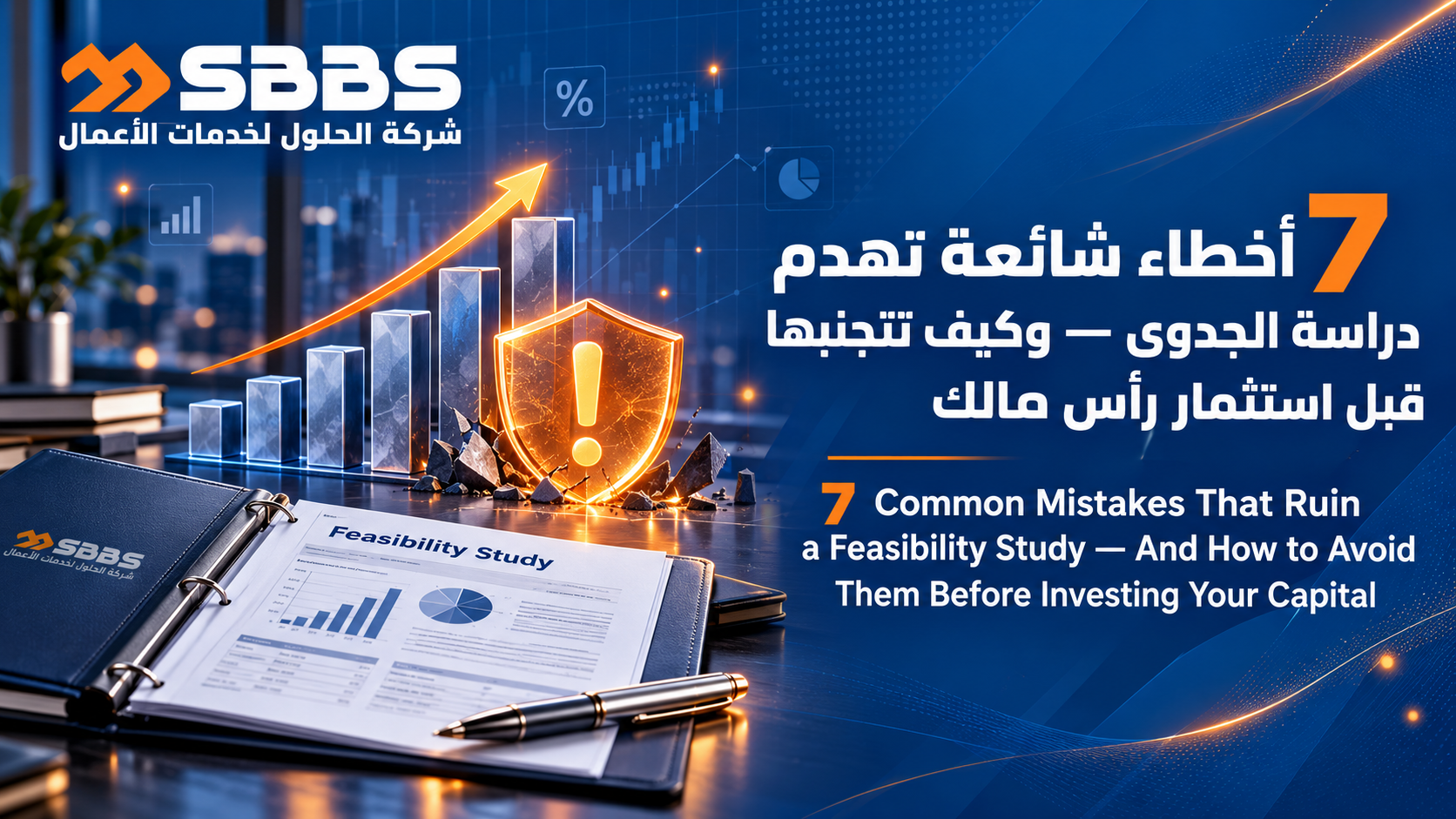
7 Common Mistakes That Ruin a Feasibility Study — And How to Avoid Them Before Investing Your Capital
Falling into common mistakes in a feasibility study is the hidden reason why a high percentage of promising ventures falter the moment they move from paper to reality.
This failure happens when theoretical projections disconnect from actual operational requirements, rapidly draining cash liquidity and freezing capital during the early foundation stages.
Therefore, protecting your investment begins with adopting an integrated evaluation methodology that combines scientific precision with hands-on executive experience in your target market before deploying your funds.
Common Mistakes in a Feasibility Study
The most critical common mistakes in a feasibility study include building a project on overly optimistic expectations without real market data, copying ready-made templates unsuited to the business, and focusing on paper profits while neglecting technical feasibility, cash flows, break-even points, legal licensing, and price updates.
To safeguard your capital in accordance with international standards established by the United Nations Industrial Development Organization (UNIDO), you must audit your study and ensure it is free from these seven fatal flaws:
-
Relying on optimistic expectations: Estimating sales based on personal enthusiasm rather than field market research and official statistical data.
-
Copying a ready-made feasibility study: Using generic, pre-packaged templates that ignore your geographic location, capital structure, and local customer behavior.
-
Ignoring technical and operational feasibility: Focusing solely on profit tables while neglecting equipment specifications, facility requirements, supply chains, and production capacity.
-
Overlooking the break-even point and cash flows: Confusing accounting profit on paper with having sufficient cash liquidity to cover monthly operating expenses.
-
Neglecting legal feasibility and licensing: Failing to calculate the time and cost required to obtain industrial, commercial, and environmental permits and tax compliance.
-
Absence of risk sensitivity analysis: Building the financial model on a single static scenario without stress-testing against rising costs or declining sales.
-
Failing to update the study when the market changes: Executing a project based on an outdated study whose figures no longer reflect current inflation and exchange rates.

Market and Operational Mistakes That Disconnect the Study from Reality
The earliest common mistakes in a feasibility study emerge when a project is planned behind closed doors, isolated from real market dynamics and daily on-the-ground operational requirements.
Even the most polished document loses its value if it relies on optimistic expectations without real market data, copies a ready-made feasibility study, or focuses on financial figures while ignoring technical feasibility.
1. Relying on Optimistic Expectations Without Real Market Data
Many entrepreneurs fall into the trap of excessive enthusiasm for their business idea, assuming customers will buy their product immediately upon launch without verifying actual market demand.
In simple terms, this mistake means calculating your projected revenues based on "what you wish to sell" rather than "what customers actually buy" or what competitors currently offer in your target region.
To avoid this pitfall, you must gather primary field data and rely on verified official statistical agencies in your target country, such as:
-
In Saudi Arabia: Sector reports and demographic data from the General Authority for Statistics (GASTAT).
-
In Egypt: Economic bulletins published by the Central Agency for Public Mobilization and Statistics (CAPMAS).
-
In the Sultanate of Oman: Official market indicators from the National Centre for Statistics and Information (NCSI).
Furthermore, an accurate market study must answer three straightforward questions before recording a single sales figure:
-
What is the actual market gap? This measures the real difference between current customer demand and the volume of products or services already supplied by competitors.
-
What is the customer's purchasing power? Does your proposed pricing match the disposable income of your target segment compared to existing alternatives?
-
What is the Customer Acquisition Cost (CAC)? What realistic marketing budget must you spend to convince a customer to switch from competitors and buy from you?
2. Copying a Ready-Made Feasibility Study Without Customizing It to Your Project
Some investors download pre-written feasibility studies from the internet or purchase an old study for a similar project to save time and consulting fees.
To simplify the concept, imagine constructing a factory or a medical center using architectural blueprints designed for a different plot of land with different soil and dimensions; structural collapse is inevitable.
A business model that succeeds in one city may fail in another due to differences in commercial rent, labor wages, shipping tariffs, and local purchasing habits.
Therefore, designing the detailed steps and elements of an economic feasibility study must be tailored specifically to your capital size, geographic location, and market entry timing.
3. Ignoring Technical Feasibility and Focusing Only on Financial Figures
Many business owners skip directly to the financial summary tables at the end of the study, overlooking the technical and operational details that explain how the business will function day to day.
Technical feasibility is simply the daily engine of your project; it answers the question: "How will we manufacture the product or deliver the service step by step, and what tools and resources are required?"
Neglecting the comprehensive guide to technical and operational feasibility can lead to discovering—after signing a lease—that the facility cannot structurally support your machinery or lacks sufficient electrical load and water supply.
A thorough technical review rests on four practical pillars that cannot be ignored:
-
Determining actual production capacity: Calculating the maximum daily output your equipment and workforce can achieve while accounting for routine maintenance and natural downtime.
-
Planning supply chains and vendors: Verifying the availability of raw materials locally or internationally, backed by transportation and warehousing plans that prevent sudden production halts.
-
Estimating waste and spoilage rates: Calculating the financial cost of raw materials lost or damaged during manufacturing, packaging, transit, or storage.
-
Defining human and technological needs: Identifying the exact number of skilled workers required alongside the software and ERP systems needed to manage operations.
💡 Executive Tip: Avoiding these operational blind spots requires an advisory team that bridges field market research with technical and logistics planning—a methodology applied by the experts at SBBS Integrated Business Services to ensure every project is executable on the ground.

Financial and Strategic Mistakes That Threaten Project Sustainability
The most dangerous common mistakes in a feasibility study revolve around incomplete financial calculations that conceal severe cash flow deficits behind attractive paper profits.
This strategic flaw becomes evident when overlooking the break-even point and detailed cash flows, neglecting legal feasibility and licensing, omitting risk sensitivity analysis, or failing to update the study when market conditions change.
4. Overlooking the Break-Even Point and Detailed Cash Flows
Many first-time investors assume that as long as a project shows "accounting profits on paper," it is financially safe—one of the most destructive misconceptions in business.
To illustrate simply: you might sell a batch of goods to a corporate client for $\$1,000,000$ on credit to be collected after 4 months; on paper you are profitable, but your bank account today is empty.
If you lack actual cash liquidity to pay rent, employee salaries, and utility bills at the end of the first and second months, your business will halt despite being "theoretically profitable."
Consequently, a professional financial study must focus on three core pillars explained in our guide to mastering financial feasibility and profitability metrics (NPV & IRR):
-
Break-Even Point: The exact sales volume at which your total revenues equal your total expenses (zero profit and zero loss), calculated using the standard formula:
-
BEP (units) = Fixed Costs ÷ (Selling Price per Unit - Variable Cost per Unit)
-
Working Capital: The cash reserve that must be set aside to cover monthly operating expenses (payroll, rent, raw materials) until the project reaches its break-even point.
-
Monthly Cash Flow Statement: A detailed schedule tracking the exact timing of actual cash inflows and outflows in your bank account to prevent sudden liquidity crunches.
5. Neglecting Legal Feasibility, Licensing Requirements, and Regulatory Compliance
A feasibility study projecting high financial returns is useless if the commercial or industrial activity faces legal barriers or licensing requirements whose costs and timelines were never factored in.
Licensing procedures, fees, and durations vary significantly by sector and jurisdiction—a reality we detail practically in our guide to company formation in Egypt for foreigners through the General Authority for Investment and Free Zones (GAFI).
Similarly, regulatory frameworks differ when reviewing company formation consulting in Saudi Arabia and guidelines from the Small and Medium Enterprises General Authority (Monsha'at), or when calculating the cost of starting a company in Oman.
Forgetting to account for the months needed to secure industrial or environmental approvals means you may pay facility rent and administrative salaries for months without legally operating.
6. Absence of Sensitivity Analysis and Risk Management Scenarios
Weak studies rely on a single static scenario assuming prices will remain stable and sales will grow smoothly, without asking the vital question: "What if market conditions shift?"
Sensitivity Analysis is essentially a "stress test" conducted on paper before risking your capital in the real world, serving as a core pillar of the Project Management Institute (PMI) risk standards.
This analysis tests your project's resilience and ability to remain profitable under three realistic adverse scenarios:
-
Cost Escalation Scenario: Will the project remain viable if raw material prices or shipping rates increase by $15\%$ or $20\%$?
-
Revenue Shortfall Scenario: How will the business meet its debt and operational obligations if first-year sales fall $25\%$ below projections?
-
Launch Delay Scenario: How much additional working capital is required if machinery delivery or government licensing is delayed by 3 months?
7. Failing to Update the Study When Market Conditions Change
A feasibility study is not an evergreen document valid forever; rather, it is a snapshot reflecting equipment costs, construction materials, and exchange rates at the exact moment it was prepared.
If you commission an excellent feasibility study today but postpone execution for 6 to 12 months, most of its financial figures will become obsolete as a foundation for investment.
Launching execution based on outdated numbers exposes you to running out of capital mid-way due to inflation, interest rate shifts, and changing import tariffs.
For this reason, adopting the digital feasibility study revolution and dynamic financial modeling has become essential to update assumptions immediately whenever market variables fluctuate.
💡 Financial & Legal Tip: To protect your project's liquidity and ensure regulatory compliance from day one, SBBS advisors link the financial study directly with accounting systems and financial development services while completing all corporate licensing procedures.

How to Ensure an Accurate Feasibility Study from the Start?
Immunizing your investment against common mistakes in a feasibility study does not require overcomplication; it relies on a structured methodology that builds an integrated linkage between study phases and actual execution, applies a quality review checklist, and combines scientific precision with executive experience.
Integrated Linkage Between Study Phases and Actual Execution
A feasibility study succeeds when built as a comprehensive executive roadmap that guides the investor seamlessly from initial concept to legal incorporation, operation, and growth.
Market research should never be isolated from marketing strategy and brand positioning, nor should technical and financial studies be separated from company registration, industrial licensing, and supply chain design.
When a study is prepared by an institution that manages subsequent execution phases, every figure placed in the tables reflects a verified, real-world cost ready for immediate implementation.
A Quality Checklist to Review Your Feasibility Study Before Approval
To help you evaluate any feasibility study currently on your desk, the following table highlights the decisive differences between a superficial paper study and an integrated executive study:
|
Audit & Review Criterion |
Superficial Paper Study (High Risk) |
Integrated Executive Study (SBBS Methodology) |
|
Market Data Sources |
Personal assumptions and undocumented general estimates |
Official statistics + field surveys and competitor analysis |
|
Project Customization |
Recycled generic templates ignoring time and location |
Custom-built for the project's location, capital, and target country |
|
Technical & Logistics Feasibility |
Theoretical overview of equipment without an operational plan |
Precise definition of production capacity, vendors, and supply chains |
|
Legal & Licensing Feasibility |
Omission of permit fees, timelines, and government regulations |
Full mapping of incorporation, industrial, and environmental permits |
|
Financial Model & Liquidity |
Focuses solely on annual accounting net profit on paper |
Monthly cash flows, break-even point, and accurate working capital |
|
Risk & Sensitivity Management |
Single static scenario assuming fixed prices and demand |
Sensitivity analysis testing cost increases or sales declines |
The Importance of Combining Scientific Precision with Executive Experience in the Target Market
Academic models and accounting formulas alone are insufficient to build a successful enterprise if the study's author is disconnected from government procedures and daily commercial operations.
Conversely, traditional trade experience without rigorous financial and statistical modeling can trap an investor in severe calculation errors when estimating Return on Investment (ROI).
Therefore, merging scientific precision with on-the-ground executive experience in regional markets is the true guarantee for transforming numbers into a profitable, sustainable corporate entity.
💡 Advisory Summary: This synergy between rigorous scientific methodology and over 15 years of field experience across Arab markets is reflected in the SBBS Economic Feasibility Studies Portfolio across hundreds of industrial, medical, service, and technology projects.
Start Your Project on a Solid Foundation with Feasibility Study Experts at SBBS
Do not leave your capital and investment ambitions hostage to overly optimistic estimates or generic templates that could cost you multiples of their price when colliding with market reality.
At Solutions Bureau for Business Services (SBBS), we do not simply sell a paper document and end our relationship upon delivery; we act as your strategic and executive partner managing the entire project journey:
-
Comprehensive Feasibility Studies: Field market research, precise technical and engineering assessments, and advanced financial models covering cash flows, break-even points, profitability metrics (NPV and IRR), and sensitivity analysis.
-
Company Formation & Government Licensing: Completing all legal incorporation procedures, commercial registrations, and industrial and environmental licenses across Egypt, Saudi Arabia, Oman, Bahrain, and wider Arab markets.
-
Operational Enablement & Sustainable Growth: Designing accounting and financial systems, internal control and assurance services, supply chain and logistics planning, digital transformation, and business development strategies.
Backed by over 15 years of experience, a track record of 300+ completed projects, and 500+ satisfied clients, we invite you today to contact the SBBS advisory team to commission an accurate feasibility study for your upcoming venture or audit and update your existing study before deploying capital.
Frequently Asked Questions About Common Mistakes in a Feasibility Study
Do these mistakes happen even in studies prepared by specialists?
Yes, these mistakes can occur if the study is prepared solely by a financial accountant working in isolation from operational reality; an accountant alone may not know industrial licensing requirements, supply chain bottlenecks, or marketing acquisition costs, which is why a study requires a multidisciplinary advisory team.
How can I verify that my project's feasibility study is free from these mistakes?
You can verify your study's reliability by checking five core elements: documented market data from recent official sources, detailed technical and licensing costs, a monthly cash flow statement separate from the income statement, accurate break-even and working capital calculations, and a multi-scenario sensitivity analysis.
What is the most dangerous financial mistake that causes projects to falter after launch?
The most dangerous financial mistake is confusing "accounting profit on paper" with "actual cash flow," alongside failing to allocate sufficient working capital to cover monthly operating expenses (rent, payroll, utilities, and raw materials) during the early months before reaching the break-even point.
Why are ready-made or free feasibility studies unsuitable for building a successful business?
Ready-made studies lack spatial and temporal customization; they are built on outdated prices and cost structures and ignore actual competitor density in your geographic area, local licensing regulations, and your specific capital structure, rendering their projections completely misleading in practice.
When does a feasibility study become outdated and require updating before execution?
A feasibility study must be updated if more than 6 months have passed since its preparation without execution, or immediately following major economic shifts such as currency exchange rate fluctuations, rising inflation and interest rates, or new amendments to investment laws, customs, and tax regulations.
Conclusion
Recognizing and avoiding common mistakes in a feasibility study—ranging from misleading market projections and generic templates to neglecting technical feasibility, licensing, cash flows, and the break-even point—is the decisive difference between a venture born to scale and one that falters at its first operational test.
Always remember that major investment decisions are never built on intuition or guesswork, and investing in an accurate, reality-based feasibility study is the most cost-effective insurance policy to protect your capital and multiply your returns with confidence.
Take your first step on a solid foundation today, and contact the business advisors at SBBS Solutions to obtain an integrated executive feasibility study that transforms your investment ambition into a thriving, sustainable corporate reality.