
Compare types of companies in Saudi Arabia for foreign investors. Learn LLC, branch, and joint stock rules, MISA registration, and 100% ownership with SBBS.
If you are planning to enter the Saudi market, evaluating the types of companies in Saudi Arabia for foreign investors can feel daunting, your decision dictates your legal liability, capitalization, and daily governance, while selecting an ill-fitting structure causes severe administrative hurdles and expensive restructuring down the road.
This complexity accelerated following the modern Saudi Companies Law and the updated Investment Law, many circulating guides conflate legal forms with investor registration, present contradictory capital figures, and overlook mandatory compliance for foreign entrants, including negative lists and specific eligibility tracks.
To eliminate guesswork, we present this structured, practical guide grounded in official statutory frameworks, by understanding your options clearly, you will select the ideal vehicle for your venture, knowing that specialized, licensed on-the-ground advisory streamlines your journey and shields your capital from costly oversights.
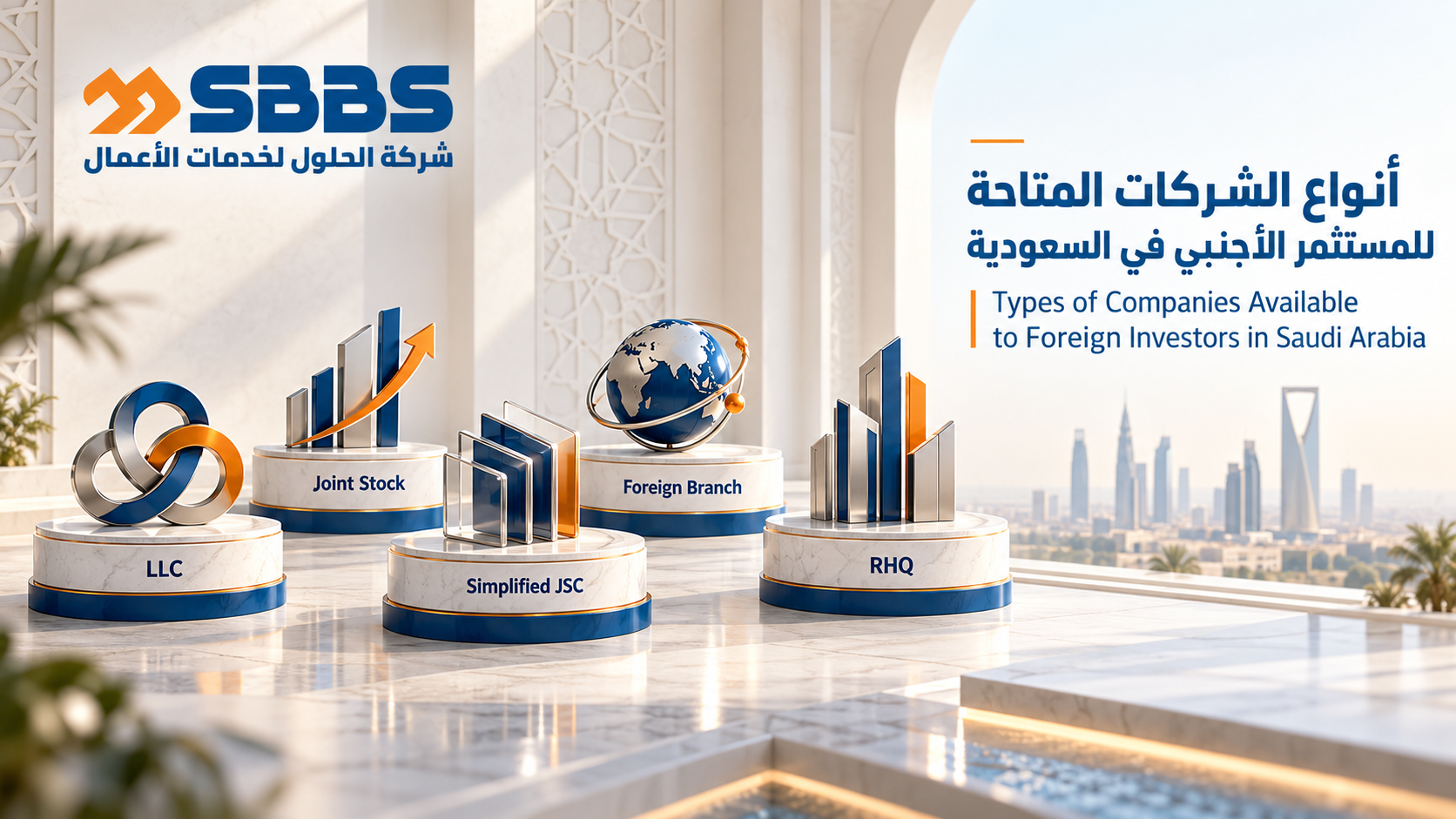
Types of Companies Available to Foreign Investors in Saudi Arabia
Types of companies in Saudi Arabia for foreign investors comprise five primary legal vehicles: Limited Liability Company, Joint Stock Company, Simplified Joint Stock Company, Foreign Branch, and Regional Headquarters, mandatory investor registration via the Ministry of Investment (MISA) precedes incorporation, enabling 100% foreign ownership across most open industries, the Limited Liability Company remains the most favored vehicle, examined below:
1. Limited Liability Company (LLC) — Including Single-Member LLCs
An LLC is your premier vehicle if your priority is protecting your private wealth; your personal financial exposure is strictly confined to your subscribed share capital, leaving personal assets insulated from corporate debts.
-
Ownership Flexibility: You can incorporate independently as a 100% foreign-owned single-member LLC, or partner with co-investors.
-
Streamlined Management: Managed directly by an appointed General Manager or a compact board of managers, bypassing complex board mandates.
-
Target Sectors: Perfectly suited for commercial trading, professional services, technology, and small-to-medium contracting initiatives.
2. Joint Stock Company (JSC) — Closed and Publicly Listed
Think of a Joint Stock Company as an enterprise whose capital is partitioned into equal, tradable shares, this vehicle is engineered for large-scale industrial projects requiring substantial funding, multiple institutional partners, or ventures targeting a future public listing.
-
Capital Threshold: The Saudi Companies Law mandates a minimum issued share capital of SAR 500,000, with at least 25% paid up upon incorporation.
-
Statutory Governance: Subject to rigorous oversight, requiring a formal board of directors (at least three members) and an independent licensed statutory auditor.
-
Capital Market Ready: Serves as the designated gateway for institutional ventures intending to list shares on the Saudi Exchange (Tadawul).
3. Simplified Joint Stock Company (SJSC)
The Kingdom established this modern vehicle specifically for innovative entrepreneurs, venture-backed startups, and agile enterprises, it delivers the prestige and share-issuance power of a conventional Joint Stock Company without burdensome compliance obligations.
-
Zero Minimum Capital: The law establishes no statutory minimum capital requirement, permitting founders to incorporate according to realistic budgetary needs.
-
Flexible Administration: You can lead the firm individually as President, appoint an executive manager, or structure committee governance without an obligatory board.
-
Investor Friendly: Enables the issuance of diverse share classes (preferred, ordinary, employee-allocated), streamlining institutional venture financing rounds.
4. Branch of a Foreign Company
For established foreign corporations expanding into the Kingdom, a branch is not an independent corporate entity, instead, it serves as a direct operational arm and local office of your overseas parent company within Saudi territory.
-
No Separate Capital: Requires no separate standalone share capital deposit, as the overseas parent company provides full financial and operational backing.
-
Legal Liability: The foreign parent company assumes complete, unlimited legal and financial liability for all local contracts, claims, and obligations.
-
Strategic Utility: Ideal for international contractors and multinationals executing specific public-sector tenders or long-term operational contracts under an established global brand.
5. Regional Headquarters (RHQ) for Multinational Enterprises
The RHQ framework is not an outlet for commercial trading or direct retail sales to consumers, it serves as the strategic corporate hub directing, supervising, and supporting affiliate branches across the Middle East and North Africa (MENA).
-
Major Tax Relief: Enjoys an exceptional 30-year 0% corporate income tax and withholding tax holiday on eligible regional headquarters activities.
-
Government Procurement Access: Grants immediate eligibility to compete for major Saudi government tenders, alongside expedited executive work visa allocations.
-
Restricted Scope: Confined strictly to strategic planning, regional treasury, executive coaching, and marketing support exclusively for subsidiaries.
Regulatory Note:
Saudi jurisprudence encompasses general partnerships and limited partnerships, we advise international clients to avoid them; general partners shoulder unlimited personal liability across private wealth for commercial debts—an unacceptable exposure for cross-border investments.
Fundamental Differences and Legal Liabilities of Each Vehicle
Benchmarking types of companies in Saudi Arabia for foreign investors requires a granular review of operational duties and legal consequences,incorporating is not a cosmetic filing; it governs financial exposure, daily governance, and long-term tax liabilities across the Kingdom:
-
Legal Liability and Juridical Personality: In LLCs and Joint Stock companies, your firm possesses an independent juridical personality safeguarding your personal wealth; your liability is capped strictly at your subscribed equity, conversely, a foreign branch lacks independent personality, leaving your overseas parent company fully liable for all local obligations.
-
Capital Requirements: The revised framework imposes no statutory minimum capital on LLCs or Simplified Joint Stock Companies, whereas conventional Joint Stock entities require SAR 500,000, regulated high-impact sectors (such as large-scale retail trading) enforce specific sectoral capital benchmarks.
-
Daily Management and Governance: LLCs operate through an appointed General Manager or managers, Simplified Joint Stock Companies permit executive leadership or agile committees, conventional Joint Stock firms mandate a formal 3-member board, and branches are directed via a corporate Power of Attorney.
-
Taxation and Periodic Compliance: Your foreign equity share is subject to a 20% corporate income tax levied on net adjusted profits by the Zakat, Tax and Customs Authority (ZATCA), alongside mandatory annual financial submissions via "Qawaem" and periodic MISA investor record updates.
Comparison Matrix: Corporate Vehicles for Foreign Capital
|
Corporate Vehicle |
Legal Liability |
Minimum Capital |
Governance Structure |
Juridical Personality |
Ideal For |
|
Limited Liability (LLC) |
Limited to share capital |
Set by founders (sector-dependent) |
General Manager or Managers |
Fully independent |
Commercial, trading, service SMEs |
|
Simplified Joint Stock (SJSC) |
Limited to share value |
No statutory minimum |
President, Manager, or Committees |
Fully independent |
Fast-growth startups, VC-backed tech |
|
Joint Stock Company (JSC) |
Limited to share value |
SAR 500,000 minimum |
Formal Board (3+ directors) |
Fully independent |
Megaprojects, capital-intensive, IPO |
|
Foreign Branch |
Unlimited on parent firm |
No standalone capital required |
Branch Manager via PoA |
Dependent on parent |
Global contractors fulfilling projects |
|
Regional HQ (RHQ) |
Dependent on incorporation |
No commercial trading capital |
Dedicated regional management |
Corporate supervisory entity |
Multinationals directing MENA branches |
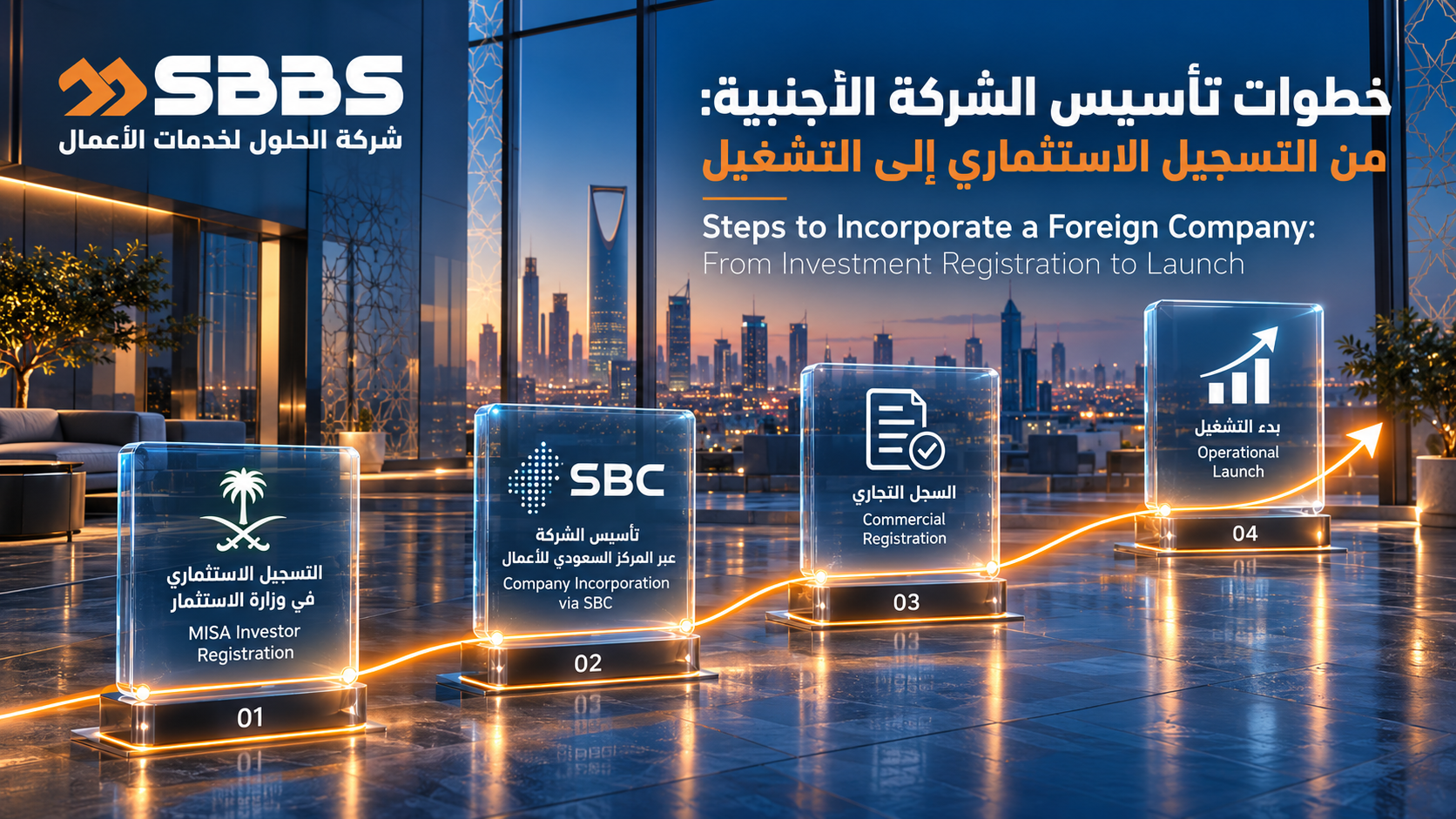
Steps to Incorporate a Foreign Company: From Investment Registration to Launch
Once you identify the best fit among the types of companies in Saudi Arabia for foreign investors, execution begins, incorporation follows a streamlined, highly digitized sequence ensuring regulatory compliance:
1. Investor Registration Criteria with MISA
The historical licensing regime has been superseded by modern «Investor Registration» in the National Register of Investors at the Ministry of Investment (MISA), with specific requirements tailored to your legal status:
-
For Individual Investors (Natural Persons): If you wish to incorporate and hold 100% equity in your individual capacity without an overseas corporate parent, regulations require holding Saudi Premium Residency (such as the Business Investor or Entrepreneur product) or GCC citizenship, premium Residency holders are exempted from overseas parent entity requirements.
-
For Corporate Investors (Overseas Juridical Entities): The foreign parent corporation must possess an active operational history of at least one full fiscal year, supported by certified documentation:
-
Commercial Registration: A valid corporate registration certificate authenticated up to the Saudi Embassy (or verified via Apostille).
-
Audited Financial Statements: Certified financial statements and balance sheets for the last completed fiscal year confirming financial solvency.
-
Articles of Association: The certified constitutional charter and bylaws of the overseas parent corporation.
-
Shareholders / Board Resolution: A formal, certified resolution approving Saudi expansion, appointing the local general manager, and delegating authorities.
2. Reviewing Restricted and Sector-Specific Activities
While 100% foreign ownership is standard, MISA’s Investor Guide and Negative List outline specific sectors reserved for domestic capital, such as upstream oil exploration and private security, other regulated activities (banking, insurance, healthcare, education) require upfront approvals from sectoral supervisory authorities.
3. Corporate Formation via the Saudi Business Center (SBC)
Following the issuance of your MISA investor registration, procedures transition seamlessly to the Saudi Business Center (SBC) platform to complete Ministry of Commerce formalities:
-
Trade Name Reservation: Selecting an approved, compliant commercial name.
-
Drafting Constitutional Articles: Electronically executing and notarizing your Articles of Association or Bylaws.
-
Commercial Registration Issuance: Disbursing statutory publication fees and issuing your official Commercial Register (CR).
4. Post-Incorporation Licensing and Compliance Setup
To transition into full commercial operation without exposure to penalties, the following operational files must be finalized:
-
Municipal License (Balady) & National Address: Securing verified commercial office premises and linking them to your National Address.
-
Chamber of Commerce Membership: Activating membership within the provincial chamber corresponding to your commercial location.
-
Tax Account Activation with ZATCA: Opening corporate tax files for corporate income tax, withholding tax, and VAT.
-
Labor Portals (Qiwa & GOSI): Establishing Ministry of Human Resources and social insurance portals to manage work visas and employee contracts.
-
Annual Record Maintenance: Updating your operational and financial data annually on MISA's national portal.

How to Select the Ideal Entity for Your Venture?
Selecting among the types of companies in Saudi Arabia for foreign investors hinges directly on your capitalization, commercial activity, expansion roadmap, and risk tolerance:
-
For Startups and SMEs: Select the Limited Liability Company (LLC) for commercial and service models to ensure complete personal liability protection with minimal overhead, or choose the Simplified Joint Stock Company (SJSC) for venture-backed initiatives requiring equity customization.
-
For Established Foreign Firms (Branch vs. Standalone LLC): Choose a Foreign Branch if your strategy relies on leveraging your parent firm's international brand equity for major institutional tenders, choose an Independent LLC if your priority is isolating commercial risks strictly within the Saudi legal entity.
-
For Major Capital Projects and Public Offerings: A conventional Joint Stock Company (JSC) is mandatory when managing substantial institutional syndicates, heavy capital expenditure, or executing an IPO roadmap on Tadawul.
-
For Multinational Corporations: The Regional Headquarters (RHQ) model is required if your objective is directing MENA operations from Riyadh while securing preferred access to sovereign tenders and 30-year tax relief.
Common Incorporation Pitfalls to Avoid
-
Relying on Outdated Information: Navigating setup procedures using historical articles that do not reflect the new Companies Law and 2025 Investment Law updates.
-
Neglecting Entity Age & Balance Sheet Criteria: Initiating corporate expansion with an overseas entity under one year old or lacking audited financials.
-
Equating Investor Registration with Operational Clearance: Assuming MISA registration allows active trading before obtaining commercial registers, municipal permits, and tax files.
Launch Your Saudi Business with SBBS
After exploring the types of companies in Saudi Arabia for foreign investors, execution demands a dedicated partner who ensures speed, discretion, and absolute legal compliance, freeing your leadership to drive market expansion.
At SBBS, we place our comprehensive corporate setup and business advisory infrastructure at your service, supporting you from structural analysis to operational commercial registration, all services within the Kingdom are delivered in collaboration with licensed, accredited Saudi legal practitioners and authorized partners.
Integrated Business Setup Solutions by SBBS
-
MISA Investor Registration: Enrolling your venture in the National Register of Investors to obtain your accredited foreign investor credential.
-
LLC & SJSC Incorporation: Structuring tailored constitutional bylaws, managing digital notarization, and securing official commercial registers.
-
Foreign Branch Licensing: Reviewing audited parent financials, authenticating overseas records, and licensing your operational branch.
-
Premise & Municipal Clearances: Fulfilling National Address criteria, Balady permits, and provincial Chamber of Commerce memberships.
-
Mandatory File Activation: Opening corporate tax accounts with ZATCA alongside labor portals with Qiwa and social insurance (GOSI).
Why Do International Investors Trust SBBS?
-
Over 15 Years of Excellence: A sustained track record guiding institutional growth and corporate structuring across regional markets.
-
500+ Corporate Clients: A distinguished roster of international companies, founders, and multinationals established successfully.
-
Regional & International Footprint: Strategic presence ensuring prompt coordination across borders wherever your leadership is based.
Ready to Accelerate Your Saudi Market Entry?
Schedule an initial consultation with our corporate structuring team to identify your optimal vehicle and receive a comprehensive roadmap:
Frequently Asked Questions on Saudi Company Types for Foreign Investors
Selecting among the various corporate structures raises practical questions regarding equity caps, capital limits, and timelines, below are clear, concise answers to essential investor queries:
What are the types of companies in Saudi Arabia for foreign investors?
You can establish five main corporate vehicles: the Limited Liability Company (the most common), the Joint Stock Company for large-scale operations, the Simplified Joint Stock Company for high-growth ventures, the Foreign Branch for international project execution, and the Regional Headquarters for Middle East management, all requiring prior registration with MISA.
Which company structure is best for startups and small enterprises?
The Simplified Joint Stock Company and Limited Liability Company are your premier options, both shielding your personal wealth, the Simplified Joint Stock Company imposes no statutory minimum capital and allows customized share classes to attract venture capital, whereas the Limited Liability Company provides unmatched operational clarity and straightforward day-to-day executive management.
Can a foreign national own 100% of a company in Saudi Arabia?
Yes, saudi Arabia’s updated investment regime permits 100% foreign ownership across commercial, industrial, service, and tech sectors without requiring a local partner, individual foreign nationals must hold Saudi Premium Residency to incorporate directly, or you can establish through an overseas parent firm, provided the activity is not on restricted lists.
Do I need a Saudi partner to set up my business?
No domestic shareholder is legally required for most commercial activities, you can incorporate a 100% foreign-owned single-member Limited Liability Company or Simplified Joint Stock Company independently, a Saudi partner is required only in specialized regulated industries where specific statutory rules mandate minimum domestic equity participation to secure specific operating licenses.
What is the difference between a branch and an LLC for foreign investors?
The core distinction lies in legal personality and liability insulation, an LLC is a separate corporate entity limiting liability strictly to your invested share capital, protecting your global assets, in contrast, a branch is an operational extension without distinct legal personality, leaving your overseas parent company fully liable for obligations.
Is there a minimum capital requirement for foreign companies?
Under the revised Companies Law, no general statutory minimum capital is enforced for Limited Liability Companies or Simplified Joint Stock Companies; you set capital according to your operational needs, exceptions apply to Joint Stock Companies (SAR 500,000 minimum) and select regulated commercial or financial activities enforcing designated capital thresholds mandates.
Is a MISA foreign investment license still required?
The historical ‘foreign investment license’ has been officially replaced by a faster digital Investor Registration within MISA’s National Register of Investors, this modernized procedure grants you an official investor record, enabling you to draft constitutional articles and issue your commercial register via the Saudi Business Center platform without historical bottlenecks.
How long does company incorporation take in Saudi Arabia?
With Saudi Arabia’s digital government portals, obtaining your MISA investor registration, notarizing articles of association, and issuing your commercial register typically takes 3 to 7 business days for complete files, completing post-incorporation compliance—including municipal premise licenses, ZATCA tax files, and labor activation—requires an additional seven to fourteen business days overall.
Conclusion
In this guide, we have examined the principal types of companies in Saudi Arabia for foreign investors, detailing their liability boundaries, governance models, and the official path from MISA registration to commercial launch.
Choosing the right legal entity from the outset protects your business against costly restructuring, positioning your venture for compliant, sustainable, and scalable growth within Saudi Arabia’s expanding economy.
Reach out to our advisory team at SBBS today to schedule a strategic consultation, identify your optimal corporate structure, and launch your Saudi enterprise with speed and confidence.