Your comprehensive step-by-step guide to setting up a foreign company branch in Saudi Arabia: legal requirements, differences from an LLC, and tax advantages. Partner with SBBS experts to establish your branch securely and seamlessly.
Deciding to establish a branch of a foreign company in Saudi Arabia may seem straightforward on paper, but it quickly turns into a complex journey once execution begins. Which corporate structure aligns best with your commercial activities? What specific documentation does the Ministry of Investment (MISA) require? And how can you guarantee your application won't stall over a minor procedural oversight? These are the critical questions facing every foreign investor preparing to enter the Saudi market.
The real challenge rarely lies in a lack of information; rather, it stems from fragmented, conflicting data. One source quotes a specific capital requirement, while another states something entirely different. One article outlines procedural steps, while another contrasts a branch with a subsidiary (LLC) without linking the legal structure to subsequent tax liabilities. Consequently, many investors proceed without a full roadmap, only to uncover unforeseen restrictions, hidden compliance costs, or procedural bottlenecks after spending unnecessary time and capital.
This guide consolidates the entire trajectory into a single authoritative resource: the official step-by-step formation process, the practical differences between a branch and an LLC to inform your decision, the prerequisites that must be met correctly from day one, and the tax efficiencies you risk missing without advance structural planning. By the end of this article, you will know precisely what your next step is—and where specialized expertise will save you time and overhead.
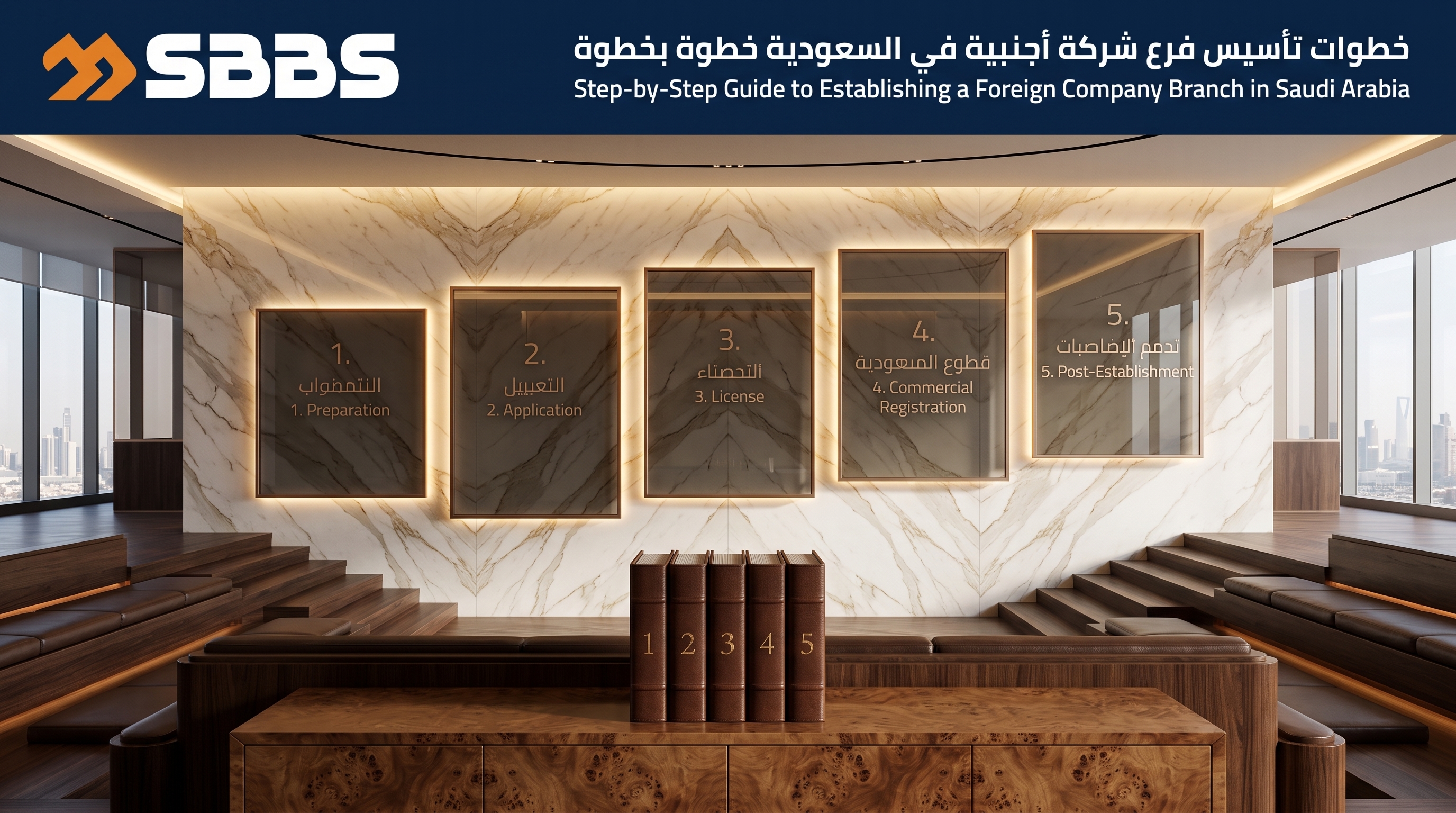
Step-by-Step Guide to Establishing a Foreign Company Branch in Saudi Arabia
Establishing a foreign branch in Saudi Arabia involves five consecutive official steps, preceded by an essential preparatory phase that sets the direction for the entire setup. The following roadmap outlines the process before we dive into the details:
Preparatory Step: The Strategic Value of a Feasibility Study Before Licensing
Before applying for any official license, a tailored market and regulatory feasibility study addresses the foundational question: Does your business model justify market entry right now, and under which legal vehicle?
-
Evaluating market demand and realistic absorption capacity for your offerings within the Kingdom.
-
Projecting financial feasibility, capital expenditure, and operating costs over the first two operating years.
-
Determining the optimal corporate vehicle: Branch Office vs. Subsidiary (LLC) (detailed in the next section).
-
Pre-screening activities against the Negative List or activities with restricted foreign equity caps.
Without this preliminary assessment, companies frequently uncover statutory restrictions or commercial hurdles after investing in licensing procedures rather than before.
Step 1: Activity Classification and Negative List Verification
Not every commercial activity allows 100% foreign ownership. Before taking any formal action, you must:
-
Align your commercial activities precisely with the standardized activity classifications recognized by the Ministry of Investment of Saudi Arabia (MISA).
-
Confirm that none of your intended operations appear on the "Negative List" of sectors closed to foreign investment.
-
Verify whether specific sector-based foreign equity ceilings apply to your commercial domain.
-
Identify any prerequisite pre-approvals if your sector falls under an independent regulator (such as the Saudi Central Bank - SAMA or the Capital Market Authority - CMA).
Step 2: Parent Company Corporate Documentation and Legalization
This stage is historically the most vulnerable to project delays, as it depends on government agencies outside Saudi Arabia. The standard documentation required from the parent company typically includes:
-
A valid Certificate of Incorporation / Commercial Registration from the country of origin.
-
Audited financial statements for the most recent fiscal year, signed off by an internationally certified accounting firm.
-
The Articles of Association (AoA) or Constitutional Charter of the parent entity.
-
A formal Board Resolution authorizing the establishment of the Saudi branch and appointing its legal representative.
-
An official Power of Attorney (PoA) granting specified authority to the Saudi branch manager.
-
Full Apostille legalization (or consular authentication for non-Hague member states) alongside certified Arabic translations by a recognized legal translator.
Step 3: Application and Issuance of the MISA Investment License
Once the parent file is fully prepared and certified, official submission begins:
-
Electronic submission via the Ministry of Investment’s (MISA) investor portal.
-
Review of legal documents, corporate standing, and business plan by MISA analysts.
-
Issuance of the Foreign Investment License upon satisfying statutory criteria.
This license serves as the core master approval for all downstream operational procedures; neither a Commercial Registration (CR) nor a corporate bank account can be obtained without it.
Step 4: Trade Name Reservation and Commercial Registration (CR) Issuance
With the MISA license in hand, the application transitions to the Ministry of Commerce (MoC) channels:
-
Reserving an exclusive commercial trade name for the branch through the Saudi Business Center (SBC) platform.
-
Drafting the Branch Resolution and constitutive documents in accordance with official Ministry templates.
-
Issuance of the official Commercial Registration (CR) certifying the branch as a registered commercial presence in the Kingdom.
Step 5: Post-Licensing Tax (ZATCA), Social Insurance (GOSI), and Regulatory Registrations
The final stage before initiating live business operations:
-
Registering the branch with the Zakat, Tax and Customs Authority (ZATCA) for Corporate Income Tax and Value Added Tax (VAT).
-
Opening a local capital/corporate bank account under the registered branch name to deposit operating funds.
-
Enrolling the corporate profile and initial personnel with the General Organization for Social Insurance (GOSI).
-
Integrating into the Ministry of Human Resources and Social Development (MHRSD) systems to comply with Nitaqat (national Saudization quotas) from day one.
Costly Procedural Errors That Cause Application Delays
The most frequent causes of delay rarely stem from the regulatory framework itself, but rather from execution flaws within the application package:
-
Incomplete document legalizations, missing Apostille stamps, or non-certified translations.
-
Selecting an activity classification that does not match the actual, operational reality of the business.
-
Powers of Attorney that lack explicit authorities required by local banks, ministries, or labor portals.
-
Failing to proactively verify sector-specific licensing restrictions before official submission.
These details may seem administrative on the surface, but they remain the primary reason applications stall for weeks without cause. Working alongside an experienced corporate services partner ensures all requirements are pre-vetted against institutional benchmarks.
Every step in this process can be derailed by a minor documentation flaw. The SBBS advisory team oversees your application end-to-end—from initial filing through to final license issuance.
Foreign Branch vs. Subsidiary (LLC): Which Structure Fits Your Business?
Both a foreign branch and a subsidiary (Limited Liability Company) allow up to 100% foreign ownership in Saudi Arabia. However, the fundamental distinction does not lie in equity ratios, but in where legal liability ultimately rests. This core difference should determine the corporate vehicle you choose.
Legal Personality and Liability for Corporate Debt
|
Structural Criteria |
Foreign Company Branch |
Subsidiary (LLC) |
|
Legal Personality |
Direct extension of the parent; no separate legal veil |
Independent, distinct legal entity |
|
Liability for Debt & Obligations |
Parent company bears 100% full liability |
Limited strictly to the LLC's paid-in capital in KSA |
|
Parent Asset Protection |
Unprotected (creditors can reach parent assets globally) |
Protected by the corporate veil |
In short: Any contractual liability, financial debt, or legal dispute incurred by the branch is directly enforceable against the parent company outside Saudi Arabia.
Equity Structure and Local Partner Flexibility
Neither entity requires a Saudi national partner across the majority of sectors open to foreign investment. The operational divergence is strategic:
-
Foreign Branch: Does not permit bringing in a local or third-party equity partner at a later stage; ownership remains tied 100% to the parent company.
-
Subsidiary (LLC): Permits introducing local partners, equity investors, or venture capital in the future without altering the underlying corporate structure.
Management Governance and Parent Reporting
-
Foreign Branch: Management decisions, operating accounts, and audited statements consolidate directly into the parent company. Governance is streamlined, as no distinct local board of directors is legally mandated.
-
Subsidiary (LLC): Governed independently inside Saudi Arabia through its own Board of Managers or General Manager. It provides superior operational independence locally, but requires standalone corporate governance compliance.
When Is a Foreign Branch the Right Strategic Fit?
A branch is typically the optimal vehicle if your situation aligns with the following parameters:
-
Your operations are tied to executing a specific, time-bound corporate project or government contract under the parent company.
-
You require unified financial reporting directly integrated with corporate headquarters without distinct local balance-sheet segregation.
-
You have no plans to bring in regional co-investors, venture funding, or local equity partners.
-
Your priority is direct execution speed over ring-fencing the parent company’s legal liabilities.
Conversely, if your corporate priority is safeguarding the parent entity's global assets, ring-fencing commercial risk, or scaling through regional strategic partnerships, an LLC is almost always the more prudent legal vehicle.
Common Pitfall: Choosing the Wrong Legal Structure
Many foreign operators opt for a branch under the assumption that it is "quicker and simpler paper-wise," failing to evaluate the long-term legal exposure placed on the global parent company. Reversing this choice later requires an entirely new incorporation, restructuring, and contract novation process.
A senior corporate structuring advisor settles this decision upfront—evaluating operational duration, balance-sheet exposure, and commercial risk, rather than convenience alone.
Selecting your legal structure is a foundational decision that is difficult to reverse post-launch. A strategic consultation with the SBBS team clarifies the optimal path for your business model before you commit.
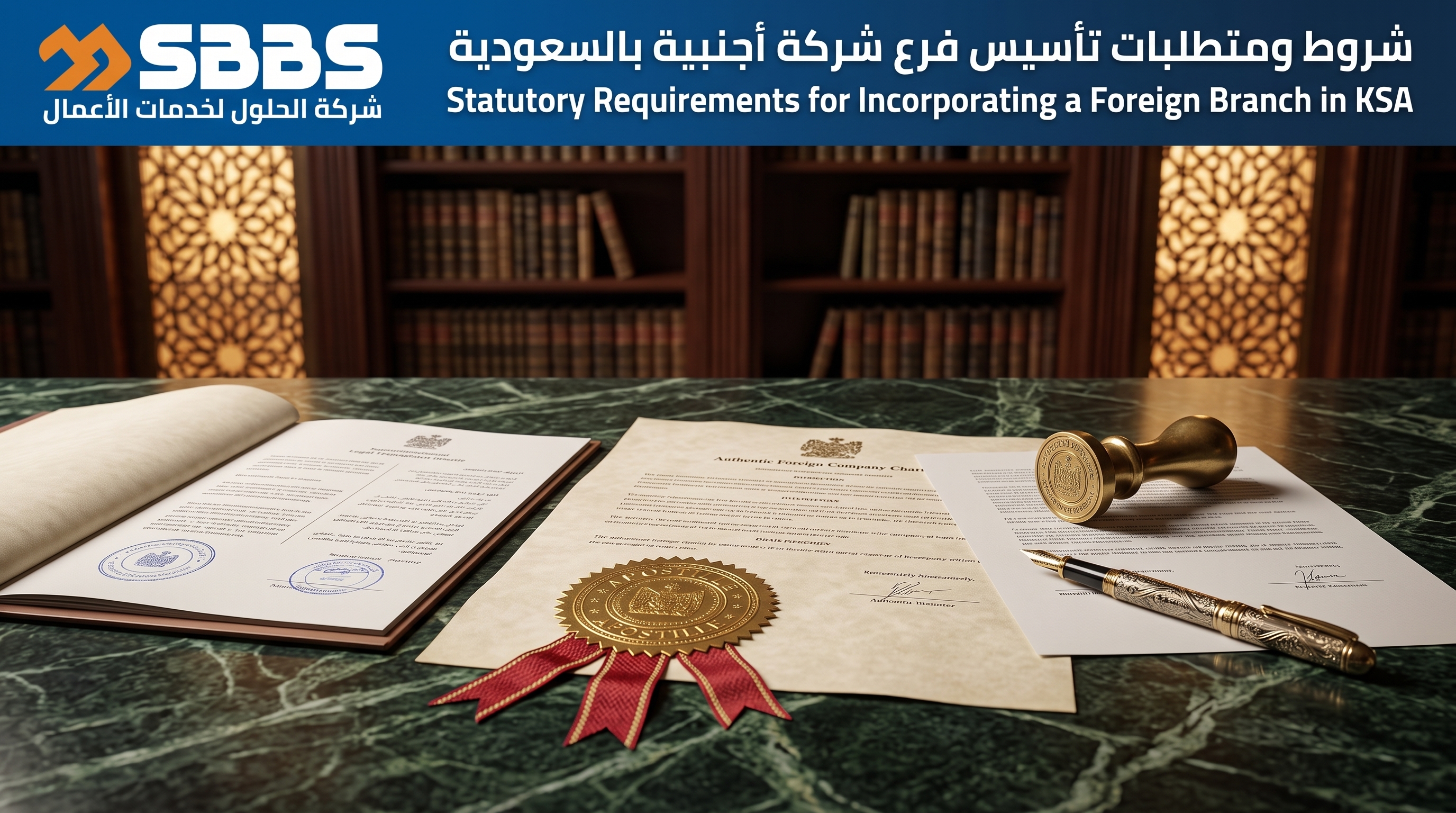
Statutory Requirements for Incorporating a Foreign Branch in KSA
Once the corporate structure is selected, a standardized framework of statutory requirements must be satisfied to secure governmental approval. The completeness of this package determines your time-to-market.
Mandatory Documents Required from the Parent Entity
Every document originating overseas must carry Apostille authentication (or consular legalization) alongside a certified legal Arabic translation:
-
Certificate of Commercial Registration / Certificate of Good Standing from the home jurisdiction.
-
Audited financial statements covering the most recent fiscal year, prepared by an accredited international auditing firm.
-
Constitutional Memorandum / Articles of Association of the parent firm.
-
Board Resolution authorizing the establishment of the branch office within the Kingdom.
-
Comprehensive Power of Attorney officially appointing the Branch General Manager.
Minimum Capital Requirements: Why There Is No Universal Figure
The Saudi legal framework does not apply a single uniform capital minimum across all commercial activities. Capital requirements vary dynamically based on:
|
Determinant Factor |
Impact on Registered Capital |
|
Activity Nature |
Each industry classification sets dedicated capital benchmarks |
|
MISA Assessment |
Ministry analysts review the business plan and evaluate capitalization adequacy |
|
Sector Mandates |
Specialized sectors (industrial, engineering consultancy, trading) follow statutory minimums |
This dynamic model explains why online searches yield conflicting capital requirements—the precise figure can only be verified once your specific activity profile is reviewed against current ministerial guidelines.
Appointing a Resident Legal Representative
MISA and Ministry of Commerce guidelines require a designated corporate officer to legally represent the branch within the Kingdom:
-
The appointed representative must hold legal residency (Iqama or GCC citizenship) in the Kingdom.
-
Powers must be documented with absolute precision inside the Power of Attorney (e.g., executing commercial agreements, managing banking facilities, representing the company before state ministries).
-
Ambiguous authorities remain one of the most common reasons commercial banks and government portals delay transaction approvals post-setup.
Sector-Specific Approvals
A MISA foreign investment license is the master commercial permit, but specialized business lines require secondary regulatory no-objection certificates:
-
Saudi Central Bank (SAMA): Banking, fintech, insurance, and lending services.
-
Capital Market Authority (CMA): Asset management, securities, and financial advisory.
-
Ministry of Health (MoH): Healthcare, clinical facilities, and pharmaceutical trading.
-
Saudi Standards, Metrology and Quality Organization (SASO): Technical conformity and consumer industrial goods.
Why Do Applications Get Rejected or Delayed?
Most administrative delays do not arise from institutional bureaucracy, but from preventable procedural gaps:
-
Submitting foreign documents lacking the mandatory Apostille chain or certified translation seals.
-
Issuing a Power of Attorney that lacks explicit powers for labor (Qiwa/Muqeem) and banking administration.
-
Proposing an operational capital figure misaligned with the intended activity class.
-
Overlooking secondary regulatory approvals that only surface upon application rejection.
Uncertain whether your corporate documentation or proposed capital satisfies MISA standards? The SBBS legal team audits your dossier prior to formal submission to prevent procedural rejections.
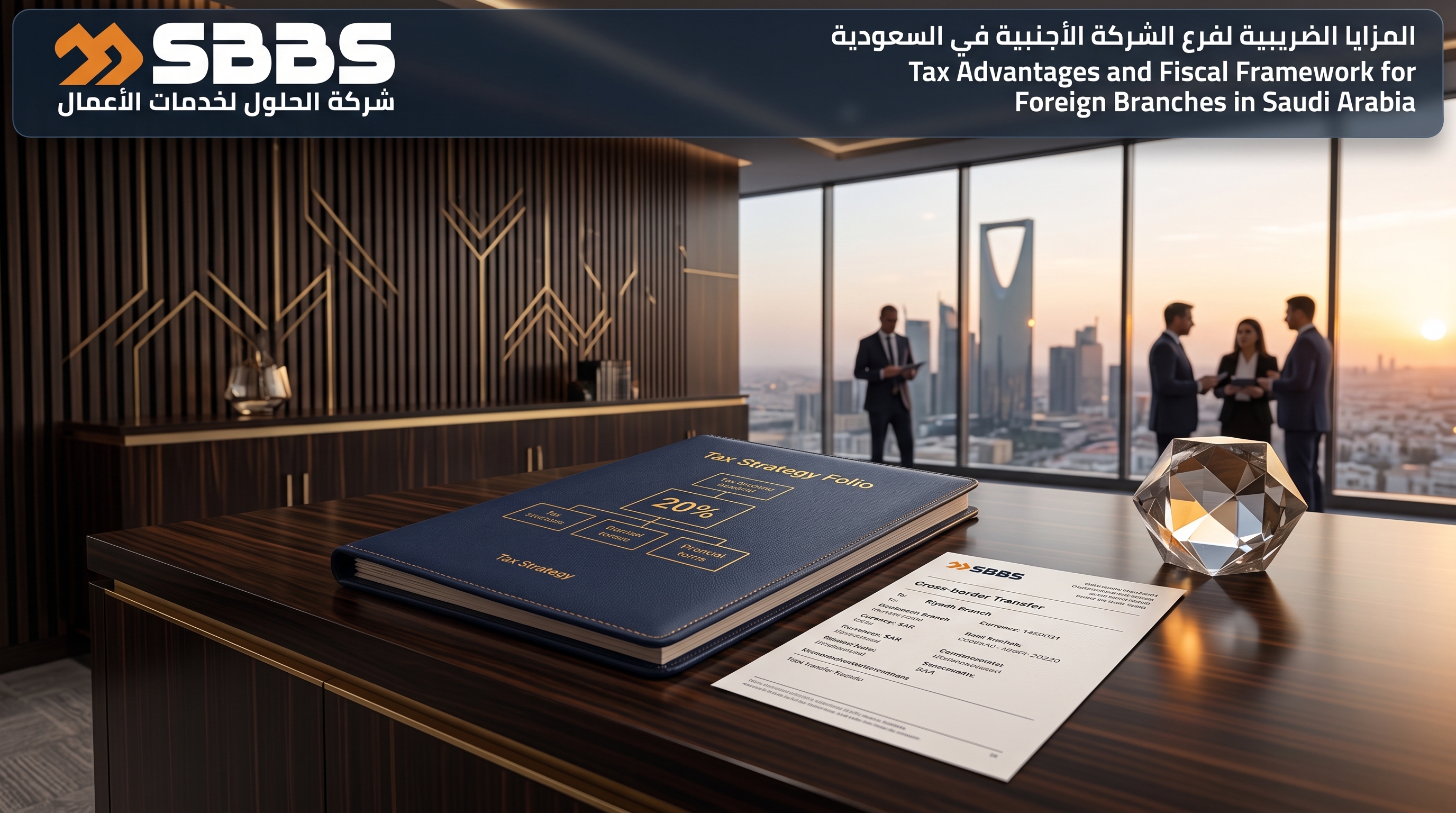
Tax Advantages and Fiscal Framework for Foreign Branches in Saudi Arabia
The local tax framework presents significant structural advantages for a 100% foreign branch compared to mixed-ownership structures. Understanding these fiscal mechanics impacts your bottom-line profitability.
Corporate Income Tax (CIT) vs. Dual-Regime (Zakat + Tax)
Because a foreign branch is 100% owned by an international entity with no GCC or Saudi shareholding, it operates under a single, direct tax framework rather than a hybrid system:
|
Tax Parameter |
Foreign Company Branch |
Subsidiary (Mixed Foreign / Saudi Shareholding) |
|
Taxable Scope |
100% of branch net operating profits |
Foreign shareholder's share of profits only |
|
Zakat Application |
Zero (Not Applicable) |
Applicable strictly to the Saudi/GCC shareholder's equity/profit share |
|
Corporate Income Tax (CIT) |
Flat 20% on entire net adjusted profit |
Flat 20% applied strictly to the foreign partner's profit share |
|
Accounting Complexity |
Single direct tax return |
Hybrid apportionment requiring dual books and filings |
Practical Takeaway: Financial reporting and annual ZATCA tax filings for a branch are mathematically cleaner, reducing audit complexities and minimizing administrative exposure.
Repatriation of Net Operating Profits to Corporate Headquarters
Saudi Arabia's modern Investment Law explicitly guarantees foreign capital the right to repatriate profits, capital gains, and operational cash flows without discriminatory currency controls. Practically speaking:
-
No unique ministerial pre-clearance is mandated to remit audited, tax-paid profits overseas.
-
Repatriations move through standard commercial banking channels under standard SAMA anti-money laundering and compliance guidelines.
-
Legally, transferring branch profits back to headquarters is not classified as a "shareholder dividend distribution," reflecting the direct legal identity between the branch and its parent.
Withholding Tax (WHT) on Cross-Border Payments to the Parent
This crucial regulatory pillar is often misunderstood or entirely omitted in generic public literature:
-
CIT and WHT are distinct fiscal regimes: Corporate Income Tax applies to the net adjusted profits earned by the branch as a permanent establishment. Withholding Tax applies strictly to designated cross-border payments made by the branch to non-resident entities.
-
If the Saudi branch remits technical service fees, royalties, software licensing, or management service charges to its foreign parent, these cross-border disbursements are subject to Withholding Tax (WHT) at statutory rates ranging from 5% to 15%, depending on the payment classification.
-
Crucial Point: Withholding taxes paid on overseas remittances cannot be deducted or credited against the branch’s 20% Corporate Income Tax liability. It represents an independent fiscal cost.
Specific withholding rates vary according to applicable Double Tax Treaties (DTT) ratified between the Kingdom of Saudi Arabia and the parent company’s domicile.
How Early Tax Structuring Prevents Penalties and Double Taxation
Corporate tax challenges rarely occur during initial incorporation; they materialize during the first full annual tax audit when intercompany payment agreements are assessed by ZATCA:
-
Pre-classifying cross-border transactions subject to Withholding Tax and formalizing transfer-pricing transfer benchmarks.
-
Structuring service-level agreements (SLAs) with corporate headquarters to eliminate tax friction and non-deductible expense write-offs.
-
Mitigating late-filing fines and classification disputes by synchronizing internal accounts with ZATCA rules from inception.
-
Leveraging active bilateral Double Taxation Treaties (DTT) to legitimately optimize withholding tax exposure.
Strategic tax planning must precede business formation, not follow it. SBBS designs your corporate fiscal architecture to safeguard against double taxation, penalties, and unexpected liabilities down the line.
From Legal Formation to Commercial Growth: The Journey Continues Beyond Licensing
Securing your MISA investment license and Commercial Registration establishes your company legally, but it does not generate commercial traction in the Saudi economy. The bridge between legal compliance and commercial expansion determines your ultimate success:
-
A valid commercial license without a focused localized go-to-market plan results in administrative overhead without commercial revenue.
-
Building high-level enterprise connections, establishing corporate credibility, and navigating regional procurement norms are essential subsequent priorities.
-
Companies that plan for regional scaling, vendor pre-qualification, and key personnel on-boarding concurrently with setup procedures capture market share substantially faster than those viewing licensing as a final milestone.
Partner with SBBS: Secure, Transparent, and Experienced Corporate Setup
Determining your legal entity, auditing corporate files, meeting regulatory capital parameters, and establishing compliant tax frameworks are high-stakes operational choices that define your commercial trajectory in the Kingdom. There is no margin for procedural trial and error.
At SBBS, we manage your full corporate lifecycle end-to-end—from preliminary feasibility advisory through to live operations.
Why Corporate Leaders Choose SBBS
-
Unrivaled Operational Experience: Over 15 years of continuous leadership in foreign direct investment, corporate structuring, and business setup across the MENA region.
-
Proven Track Record: 500+ corporate clients onboarded and 300+ cross-border restructuring and setup projects completed successfully.
-
Direct Regional Footprint: Wholly owned offices and operational teams on the ground in Saudi Arabia, Egypt, Oman, and Bahrain.
-
Comprehensive In-House Lifecycle: We are not simply filing agents; we deliver strategic market feasibility, institutional licensing, tax advisory, and post-formation compliance under one roof.
Deliverables When You Engage SBBS
-
Strategic market and structural assessment identifying the precise legal framework matching your operational goals.
-
Full-scope audit and legalization oversight of parent documentation to eliminate costly application delays.
-
Direct representation across MISA, the Ministry of Commerce, and regulatory authorities through final license issuance.
-
Comprehensive pre-incorporation tax architecture to optimize cross-border liabilities, avoid double taxation, and maintain absolute ZATCA compliance.
-
Post-incorporation corporate support—from corporate banking introductions to Saudization (Nitaqat) strategy—to scale your operations seamlessly.
Frequently Asked Questions (FAQs)
Direct, practical answers to the most common questions raised by corporate executives and legal counsels evaluating a branch setup in Saudi Arabia.
Q1: Is a foreign company branch subject to Withholding Tax (WHT)?
A foreign branch is subject to Corporate Income Tax (20%) on its net adjusted operating profit as a recognized permanent establishment. Withholding Tax (WHT) operates under an entirely separate framework: it applies strictly to specific outbound payments made by the branch to non-resident entities (such as management fees, royalties, or technical services paid to the parent company). WHT payments are non-creditable against the branch’s own income tax. Rates should be audited alongside an accredited tax advisor based on active Double Taxation Treaties.
Q2: What is the fundamental difference in legal liability between a Branch and an LLC?
A branch is a direct operational and legal extension of its parent company; the parent retains 100% full, unmitigated legal and financial liability for all branch debts and contractual commitments. A Limited Liability Company (LLC) is an independent corporate entity whose liabilities are strictly ring-fenced to its own registered share capital inside Saudi Arabia.
Q3: What are the MISA investment licensing fees and annual renewal costs?
MISA fees consist of an initial first-year licensing and advisory service fee, which then transitions to an annual renewal and service fee in subsequent operating years (the initial year carries higher administrative fees). Because statutory rates and ministerial packages are updated periodically, exact fee schedules should be verified through official channels at the time of formal filing.
Q4: How long does it realistically take to license and register a foreign branch?
Upon receiving fully attested, Apostilled, and translated documentation from the parent company, the MISA Foreign Investment License can be issued within a matter of days. Finalizing the full operational ecosystem (Commercial Registration, Chamber of Commerce, ZATCA tax file, corporate bank account, and GOSI registration) typically requires an additional 3 to 5 weeks. The primary variable governing project duration is the speed of preparing parent company foreign documents.
Q5: What is the minimum capital required to establish a foreign branch?
There is no statutory, one-size-fits-all capital amount. The required capital figure is evaluated on a case-by-case basis by MISA, determined by your specific commercial activities, planned operational footprint, and sector classification.
Q6: Does the parent company carry liability for the debts of its Saudi branch?
Yes, 100%. A branch office does not hold separate legal personality or independent financial standing distinct from the parent company. This remains the most critical strategic reality for foreign boards of directors to evaluate before choosing a branch over an LLC.
Q7: Can a foreign company branch own commercial real estate in Saudi Arabia?
Yes, but strictly for purposes directly essential to executing its licensed business operations and corporate housing, and subject to statutory approvals and regulations outlined in the foreign real estate ownership laws—not for open-ended speculative property trading.
Q8: What is the difference between an Operating Branch and a Regional Headquarters (RHQ)?
An Operating Branch conducts direct commercial, operational, and profit-generating business activities within the Saudi domestic market and is subject to standard Corporate Income Tax (20%). A Regional Headquarters (RHQ) is an administrative and strategic hub established to oversee, direct, and support corporate group subsidiaries across the MENA region. The RHQ vehicle is barred from direct commercial trading and contracting, but benefits from an exclusive 30-year tax incentive package (0% CIT and 0% WHT on qualifying RHQ operations).
Conclusion
Establishing a branch of a foreign company in Saudi Arabia follows a well-defined institutional path when approached systematically: beginning with strategic pre-incorporation planning, progressing through parent document legalization and MISA licensing, and culminating in full Commercial Registration and tax operationalization. As outlined throughout this guide, the choice between establishing a branch versus an independent subsidiary is far from a mere administrative formality—it directly defines your global balance sheet exposure and corporate tax liabilities for years to come.
With the roadmap presented here, you no longer need to navigate fragmented sources or conflicting claims regarding capital, procedures, or corporate liabilities. You now possess a clear understanding of the institutional prerequisites, the critical operational distinctions, and the preventable mistakes that cause costly delays.
When your organization is ready to transition from planning to execution, SBBS provides complete corporate partnership at every milestone—from feasibility and documentation to MISA licensing and full fiscal structuring—backed by over 15 years of boots-on-the-ground operational authority in Saudi Arabia.