Establish your foreign company in Saudi Arabia with confidence. SBBS guides you through actual fees, realistic timelines, and post-licensing compliance.
Every year, the Ministry of Investment of Saudi Arabia (MISA) issues thousands of licenses to international investors. Yet, a significant number of applications are rejected or delayed for weeks due to a single administrative misstep. Choosing the right incorporation partner in Saudi Arabia can define the trajectory of your business long before it launches.
Unclear advisory fees mixed with government charges, along with promised timelines of "a few days" that stretch into weeks, often leave investors facing a wave of complex decisions without sufficient local context. Which legal entity should you choose? Is your business activity eligible for foreign investment? And what happens after you obtain your license?
While the incorporation journey may seem complex from the outside, achieving a smooth setup on your first attempt is completely achievable when every step is clearly understood. This guide breaks down the exact process.
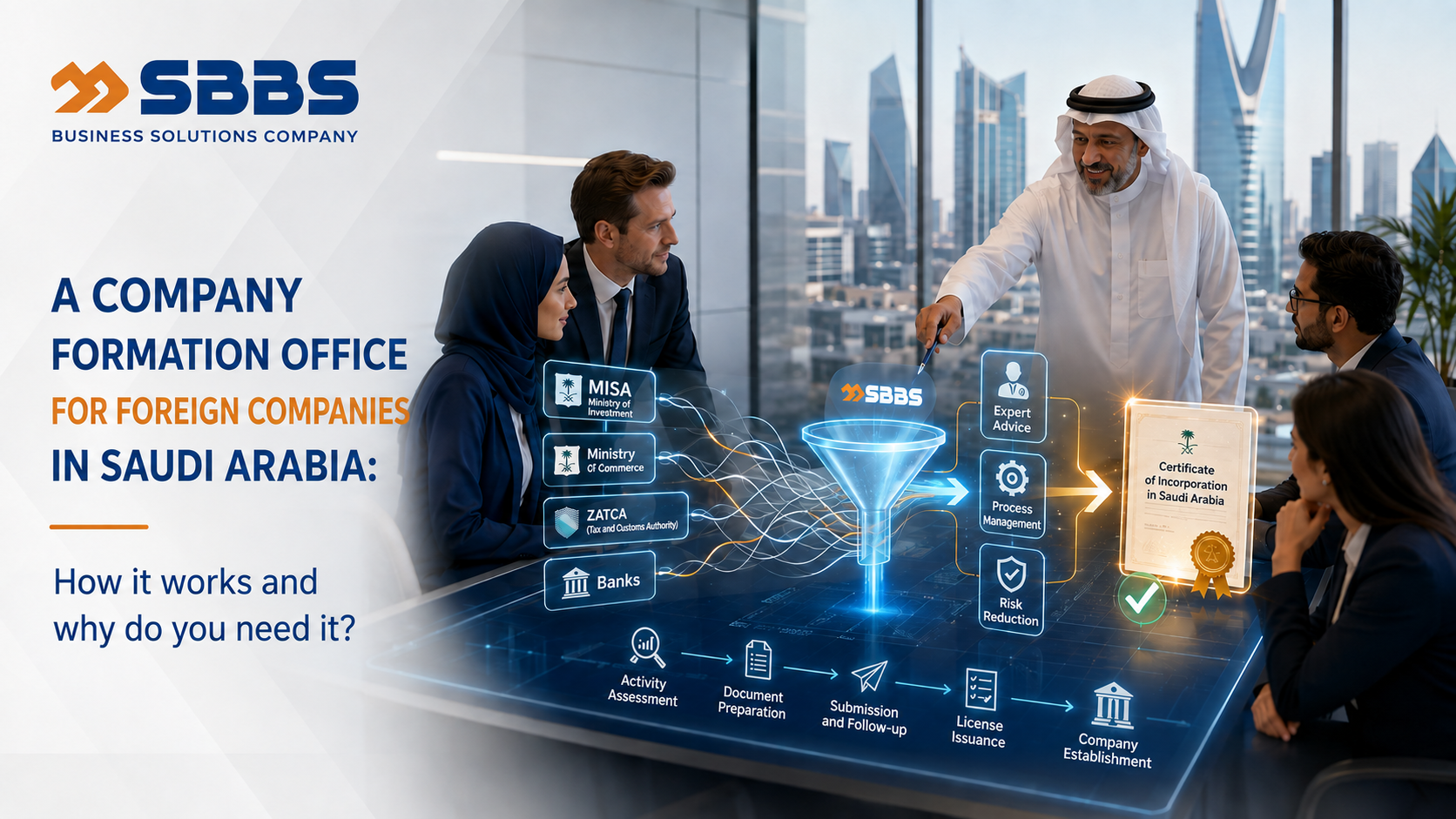
A foreign business setup firm in Saudi Arabia is a specialized entity that handles all administrative and legal procedures required to transform an international investment decision into an active, compliant legal entity ready for operations.
Instead of navigating independently between MISA, the Ministry of Commerce, the Zakat, Tax and Customs Authority (ZATCA), and the General Organization for Social Insurance (GOSI), a specialized setup firm manages the entire portfolio from the initial step to receiving an active license.
Before engaging any service provider, it is essential to understand the exact scope of services expected, the real differences between self-execution and professional assistance, how to identify a trustworthy advisory firm, and the common pitfalls to avoid.
What Does a Specialized Business Setup Firm Do?
When partnering with a specialized office to establish your foreign company in Saudi Arabia, you delegate an interconnected end-to-end process rather than isolated tasks. These services typically include:
-
Activity Eligibility Verification: Ensuring your intended business activity is permitted for foreign investors and not listed under restricted sectors.
-
Documentation & Online Submission: Preparing all required documentation and submitting the initial application electronically through the Invest Saudi portal.
-
Entity Selection: Determining whether a Branch, a Limited Liability Company (LLC), or a Regional Headquarters (RHQ) best suits your business model and operational scale.
-
Commercial Registration (CR): Securing the CR from the Ministry of Commerce following MISA license approval.
-
Drafting Articles of Association: Formulating the Articles of Association and bylaws in compliance with the Saudi Companies Law.
-
Tax & Zakat Registration: Completing tax registration with ZATCA and obtaining the Tax Identification Number (TIN).
-
Corporate Banking Setup: Facilitating the opening of a corporate bank account and documenting capital deposits where required.
-
Additional Operational Licenses: Securing sector-specific operational permits, such as industrial or professional licenses.
-
GOSI & Labor Registration: Registering with GOSI and the Ministry of Human Resources to enable lawful hiring.
Through this structured approach, a professional advisory firm goes beyond simply applying for a license—it fully equips your enterprise for operational readiness without friction at any stage.
Self-Setup vs. Partnering with a Specialized Firm
Many investors assume handling incorporation independently saves costs. However, the true difference lies not in official registration fees, but in execution risks and time-to-market.
| Comparison Point | Self-Setup | Specialized Setup Firm (SBBS) |
| Understanding Sector Restrictions | Independent research that may rely on outdated information | Direct, real-time knowledge of current regulations |
| Government Agency Coordination | Separate, manual follow-ups with multiple ministries | A single point of contact managing all agencies on your behalf |
| Parent Company Document Authentication | High vulnerability to translation and legalization errors | Properly attested documents fully compliant with official standards |
| Risk of Rejection or Delays | Relatively high for first-time applicants | Significantly minimized due to extensive case experience |
| Post-Incorporation Compliance | Fully managed by the investor | Integrated into ongoing support services |
| Actual Time-to-Market | Often extended by error corrections and resubmissions | Predictable, structured, and managed according to plan |
Self-execution rarely saves capital; instead, it shifts operational risks directly onto your business once procedures begin.
How to Select a Reliable Setup Partner in Saudi Arabia
Not all incorporation service providers offer the same depth of expertise. Prior to assigning your file, verify the following criteria:
-
Official Accreditation: Ensure the firm is registered and recognized in Saudi Arabia, rather than operating as an unverified intermediary.
-
Industry Expertise: Inquire about their track record with your specific business activity; industrial requirements differ fundamentally from commercial or service sectors.
-
Fee Transparency: A reputable partner provides an itemized breakdown separating mandatory government fees from service fees, avoiding vague estimates.
-
End-to-End Scope: Confirm that coverage extends from initial licensing to post-incorporation compliance, rather than handing over a license and leaving you to manage operations alone.
-
References & Track Record: Request relevant case studies or references from clients in similar industries.
-
Consultative Approach: The precision of questions asked during your initial discovery session indicates how thoroughly the firm understands your specific requirements.
Common Pitfalls when Dealing with Unspecialized Entities
Delays and rejections in foreign company setups often stem from repeatable execution errors, including:
-
Selecting a commercial activity code that does not match official classifications, resulting in application rejection.
-
Inadequate legalization of parent company documents, such as improper translation or missing attestations from the Saudi Embassy in the origin country.
-
Confusing the requirements of establishing a branch with those of a standalone subsidiary.
-
Overlooking minimum capital requirements specific to certain regulated activities.
-
Failing to plan for post-setup obligations, such as Saudization quotas, GOSI registration, and annual license renewals, which can lead to early compliance penalties.
Each of these challenges is preventable when working alongside an advisory team that understands Saudi Arabian corporate regulations thoroughly.
If you wish to assess whether your business activity qualifies for foreign investment prior to taking actionable steps, contact the SBBS team for an initial evaluation.
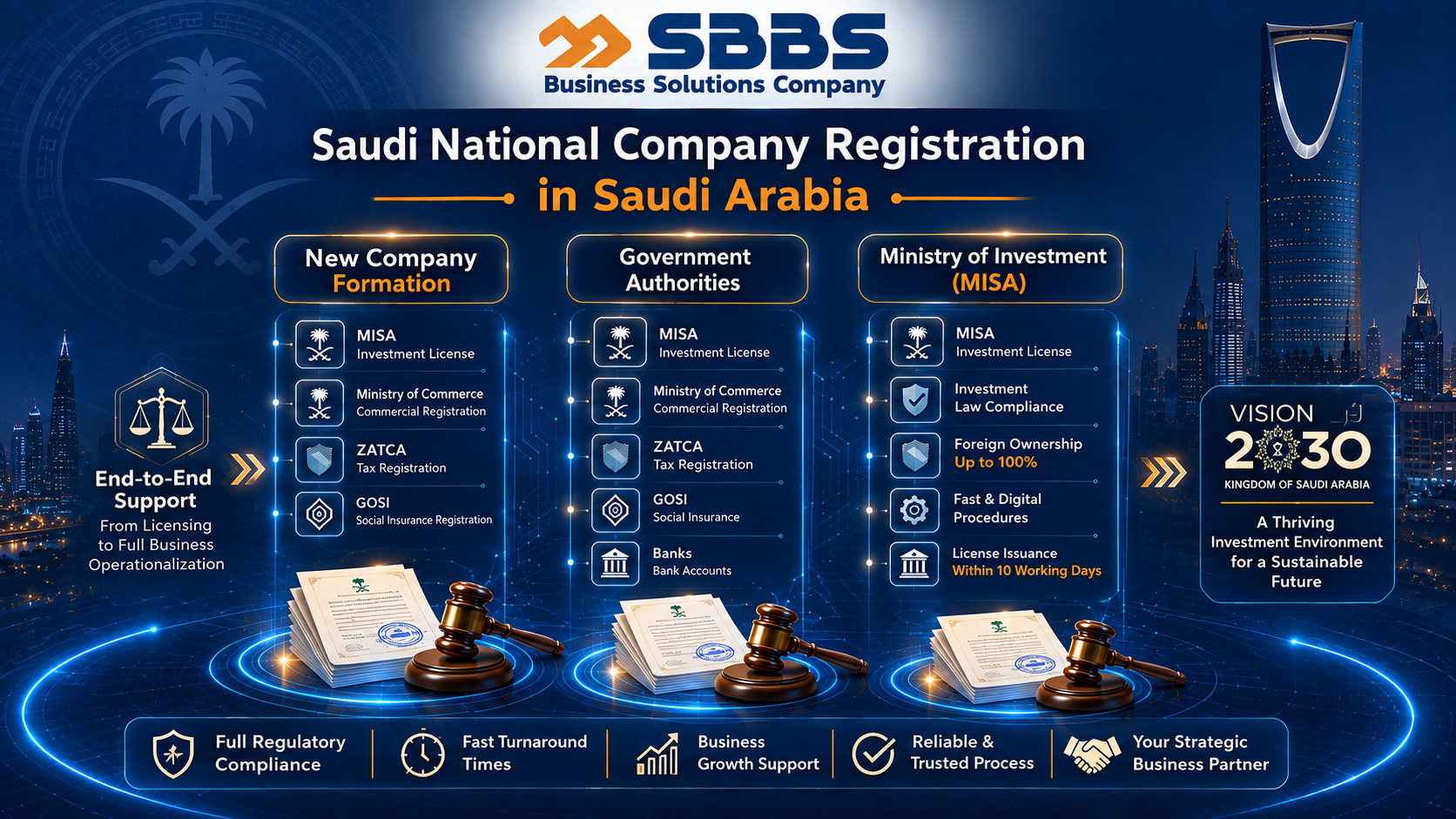
The Regulatory Framework for Foreign Business Setup in Saudi Arabia
Understanding the regulatory framework that governs foreign business incorporation enables you to evaluate the accuracy of any consulting partner and ensures your business is built on solid legal foundations from day one.
This section covers available legal entities, MISA licensing requirements, 100% foreign ownership conditions, the Regional Headquarters (RHQ) program, and critical legal mistakes to avoid.
Available Legal Entities: Branch, LLC, or Regional Headquarters (RHQ)?
Any business entity owned partially or fully by non-Saudi shareholders is classified as a foreign company under Saudi law. Four main entity structures exist:
| Legal Entity Type | Legal Nature | Foreign Ownership | Best Suited For... |
| Branch of a Foreign Company | An extension of the parent company; legal liabilities remain with the parent firm. | 100% foreign ownership permitted (unless specific sector rules apply). | Executing specific contracts directly linked to the parent company's original scope. |
| Limited Liability Company (LLC) | An independent legal entity; shareholder liability is limited to equity capital. | 100% foreign ownership allowed across most activities via MISA license. | Establishing a standalone commercial, industrial, or service enterprise. |
| Joint Stock Company (JSC) | An independent legal entity tailored for large capital and complex ownership structures. | 100% foreign ownership allowed across most activities. | Businesses planning significant equity, multi-partner structures, or future listing. |
| Regional Headquarters (RHQ) | A dedicated license for managing regional operations from within Saudi Arabia. | Designed specifically for multinational corporations (MNCs). | Managing regional operations across multiple countries without direct trading. |
Selecting the wrong legal structure early on may require starting the entire process over—a primary cause of setup delays for international investors.
Foreign Investment License (MISA): The Foundation of Every Step
Every operational milestone—from commercial name reservation to opening a bank account—begins with securing a Foreign Investment License from the Ministry of Investment of Saudi Arabia (MISA).
Operating under Foreign Investment Law (Royal Decree No. M/1), MISA regulates foreign participation, encourages inward investment, and guarantees investor rights. The typical licensing workflow follows these steps:
-
Creating an account on the Invest Saudi portal.
-
Uploading mandatory documentation (e.g., authenticated parent company CR, Articles of Association, passport copies of directors/signatories, audited financial statements for the last fiscal year, and a detailed business plan).
-
Paying official statutory fees online.
-
Application review by relevant authorities to confirm activity eligibility.
-
License issuance (often completed within days when documentation is accurate and complete).
Without a MISA license, a business cannot obtain a Commercial Registration, open a corporate bank account, or complete tax registration.
100% Foreign Ownership: Conditions and Professional Activity Pathways
While majority sectors permit 100% foreign ownership, professional activities (e.g., legal advisory, engineering consulting) follow specific operational pathways depending on foreign equity participation:
-
100% Foreign Ownership Pathway: Requires an established international track record featuring active operations across multiple overseas jurisdictions to verify genuine corporate capability.
-
25% Saudi Partnership Pathway: Relaxes the international track record requirement, making a single operational entity outside Saudi Arabia sufficient to qualify.
Post-licensing operational limits also vary by profession. For example:
-
Legal Services: 100% foreign-owned firms handle non-litigation advisory directly, while court representation remains reserved for licensed Saudi attorneys.
-
Engineering Consulting: Licensed foreign engineers registered with the Saudi Council of Engineers may practice directly without requiring local court-specific restrictions.
Regional Headquarters (RHQ) Program: Strategic Setup for Global Enterprises
For multinational enterprises operating across multiple countries, the Regional Headquarters (RHQ) framework provides a specialized alternative to standard incorporation.
Applicants must be multinational companies with existing operating entities in at least two foreign jurisdictions outside their headquarter country and Saudi Arabia. Strategic incentives include:
-
30-Year Corporate Tax Relief: 0% corporate income tax and 0% withholding tax on approved RHQ activities for 30 years.
-
Government Contracting Priority: Priority access to Saudi government procurement contracts.
-
Employment & Visa Preferences: 10-year exemption from Saudization quotas, alongside streamlined visa issuance processes for executive personnel.
Ignoring the RHQ option when expanding regional management functions could mean missing out on substantial tax and procurement advantages.
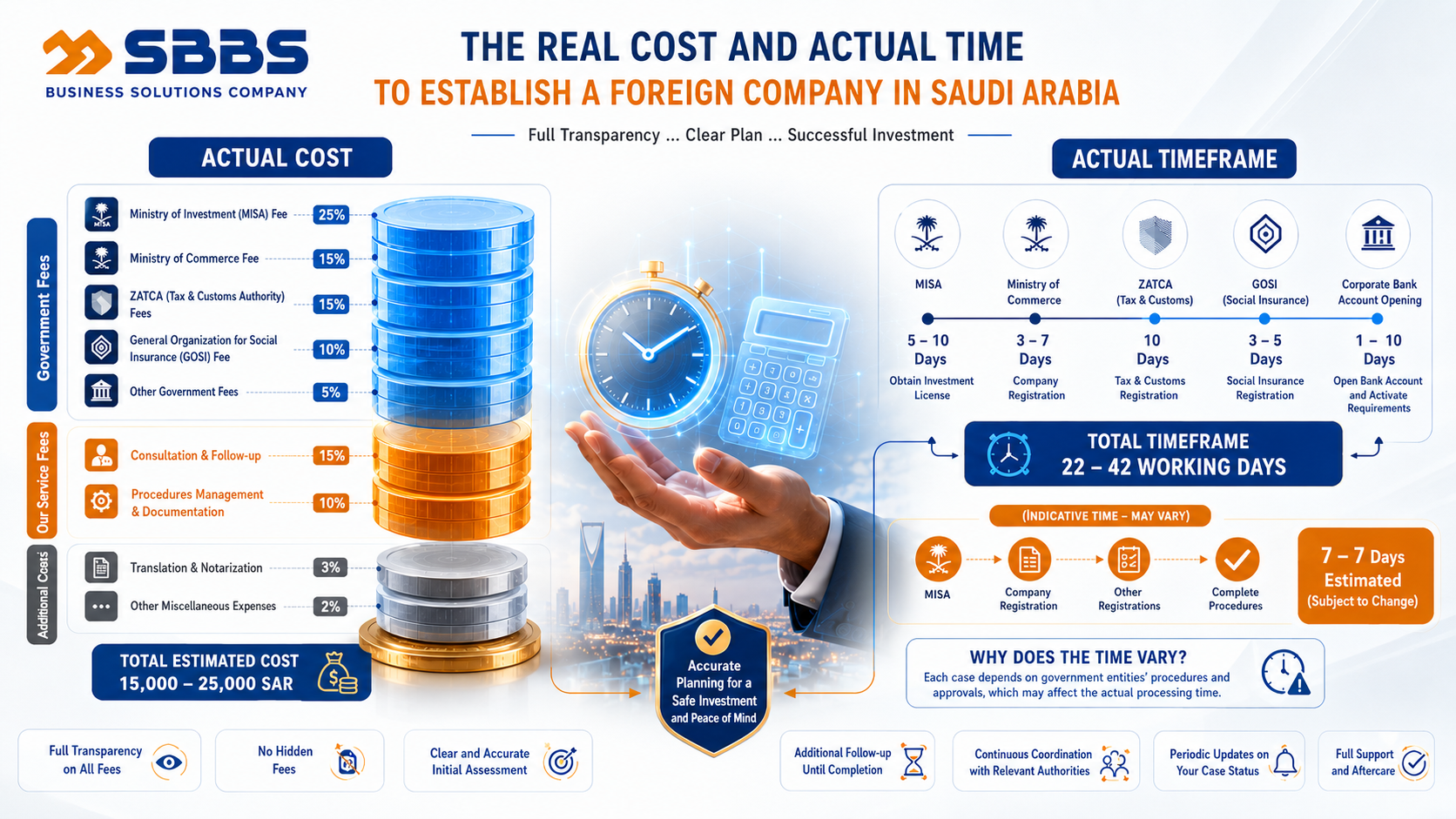
Real Costs and Timelines for Foreign Company Setup in Saudi Arabia
Budgeting accurately requires distinguishing mandatory government charges from advisory service fees.
Official Statutory Fees
Direct government fees fall into three main categories:
| Fee Category | Receiving Authority | Approximate Cost (SAR) |
| MISA Investment License (Annual) | Ministry of Investment | ~2,000 SAR / year |
| Commercial Registration (LLC) | Ministry of Commerce | 1,200 SAR |
| Commercial Registration (JSC) | Ministry of Commerce | 1,600 SAR |
| Publication & E-Attestation Fees | Various Authorities | 500 – 2,000 SAR |
| Value Added Tax (VAT) | ZATCA | 15% applied on applicable fees |
Statutory government fees typically range from SAR 2,000 to SAR 10,000, depending on entity type and the number of registered business activities. This covers official fees only and excludes third-party execution costs.
Professional Advisory Fees
Consulting fees cover execution management rather than license acquisition itself. Specialized advisory packages generally encompass:
-
Reviewing, translating, and verifying legal documentation.
-
Preparing, submitting, and tracking MISA applications.
-
Drafting compliant Articles of Association.
-
Coordinating with the Ministry of Commerce for CR issuance.
-
Facilitating corporate bank account setup.
-
Completing tax (ZATCA) and labor (GOSI) enrollments.
Depending on structural complexity, professional service fees can bring total setup costs to SAR 25,000 or more. A transparent partner itemizes these components upfront.
Factors Influencing Overall Costs
-
Multiple Business Activities: Additional commercial activities added to a single CR incur supplementary fees.
-
Capital Requirements: Minimum capital varies by industry; specific sectors (e.g., real estate development or contracting) may require higher capitalization or specialized financial guarantees.
-
Document Translation & Attestation Volume: International legalizations scale in cost based on document volume.
-
Corporate Entity Type: Branch setups differ structurally in fee schedules compared to establishing a new standalone LLC.
Realistic Setup Timelines
While initial MISA license approval typically averages 5 to 10 business days, overall time-to-market depends directly on document readiness. Common causes of extended timelines include:
-
Incomplete chains of document authentication (missing embassy attestations).
-
Mismatched business activity classifications.
-
Selecting an inappropriate legal form requiring structural revisions.
-
Delayed secondary approvals for regulated industries.
Working with an experienced team ensures application packages are submitted correctly on the first attempt, preventing unnecessary downtime.
Step-by-Step Setup Guide & Post-Incorporation Compliance
Securing a Commercial Registration represents the midpoint of your operational setup. Sustained compliance is critical to long-term operations in Saudi Arabia.
End-to-End Execution Sequence
-
Activity Definition: Confirm intended activities against current MISA classifications.
-
MISA Application: Submit parent company documentation, business plans, and financial statements via Invest Saudi.
-
Trade Name Reservation: Secure an approved trade name through the Ministry of Commerce.
-
Articles of Association: Draft and notarize corporate constitutional documents.
-
CR Issuance: Obtain official Commercial Registration.
-
Tax Registration: Register with ZATCA for corporate income tax and VAT.
-
Labor Setup: Open files with the Ministry of Human Resources and GOSI.
-
Bank Account Opening: Deposit required share capital into a local corporate account.
-
Municipal & Operational Permits: Obtain municipality (Balady) and sector-specific permits.
-
Work Visas: Issue executive and employee visas through official government portals.
Critical Mandatory Documents
-
Certified, legalised, and translated copy of the parent company’s CR.
-
Parent company Articles of Association.
-
Audited financial statements for the preceding fiscal year.
-
Official Board Resolution approving setup and appointing legal representatives.
-
Valid passports/IDs of authorized signatories.
-
Detailed business plan.
Post-Incorporation Compliance Requirements
-
Saudization (Nitaqat): Maintain mandatory local employment ratios based on sector size and activity.
-
GOSI Contributions: Process monthly social insurance contributions for registered workforce members.
-
Corporate Tax & Zakat: Foreign equity shares are subject to 20% Corporate Income Tax on net profits. Saudi/GCC shares are subject to Zakat (2.5%).
-
VAT & Withholding Tax: File periodic VAT returns (15%) and handle withholding tax returns on non-resident payments.
-
Annual License Renewals: Maintain valid MISA licenses and CR registrations annually to ensure uninterrupted banking and trade facilities.
Non-compliance carries strict penalties. Late tax filings can result in a 1% penalty on revenue for every 30 days of delay (capped at 25%), alongside 1% penalties on unpaid tax amounts per 30-day period.
Why Choose SBBS as Your Setup Partner in Saudi Arabia?
At SBBS, business incorporation is managed as a strategic partnership designed for sustained operational success:
-
Full End-to-End Management: From initial activity assessments to tax registration and ongoing compliance support, we manage the entire process seamlessly.
-
Transparent Fee Structures: Clear separation between statutory government fees and professional advisory costs—no hidden charges.
-
B2B Specialization: Proven experience assisting regional corporate expansions, professional service firms, and industrial enterprises.
-
Long-Term Support: Ongoing administrative and compliance oversight long after your license is issued.
-
Current Regulatory Expertise: Real-time alignment with the latest Saudi business laws, MISA updates, and RHQ regulations.
Ready to launch your business in Saudi Arabia cleanly and efficiently? Contact the SBBS team today for an initial consultation.
Frequently Asked Questions (FAQ)
Can a foreign investor own 100% of a company in Saudi Arabia without a local partner?
Yes. Saudi investment laws allow 100% foreign ownership across most commercial, industrial, and service activities upon securing a MISA license. Certain professional services may require specific international track records or local participation.
What is the average cost of establishing a foreign business in Saudi Arabia?
Statutory government fees generally range between SAR 2,000 and SAR 10,000. Total operational setup—including legal drafting, translations, attestations, and advisory support—typically starts around SAR 25,000, varying by entity complexity and activity type.
How long does it take to secure a MISA Foreign Investment License?
MISA licensing typically takes 5 to 10 business days once fully attested and translated application files are submitted.
What is the main difference between a Branch office and an LLC?
A Branch is an extension of the parent company without separate legal liability. An LLC is a standalone legal entity with shareholder liability limited to registered share capital.
Is a local sponsor required to start a business in Saudi Arabia?
No. The MISA licensing framework allows foreign investors to establish and own businesses directly without requiring a local sponsor across most sectors.