Discover what a feasibility study is, its execution steps, costs, and bank approval criteria. Protect your capital and secure your project's success with SBBS experts. Request your free consultation today!
Initiating a feasibility study is the critical line between a mere vision and a viable investment. According to recent statistics, roughly 90% of new projects fail in their early stages. These ventures did not lack enthusiasm; rather, they lacked rigorous pre-investment evaluation before committing capital.
Such failures routinely stem from decisions guided by intuition, an absence of real market data, and underestimating initial and operational costs. The risks compound further due to the varying regulatory frameworks and financing conditions across Egypt, Saudi Arabia, and Oman, frequently resulting in immediate bank rejections or total loss of capital.
You do not have to leave your commercial success to chance. A proven scientific methodology exists to transform your assumptions into a concrete, data-backed operational plan. Below, we explore what a professional feasibility study entails and how it serves as your primary safeguard.
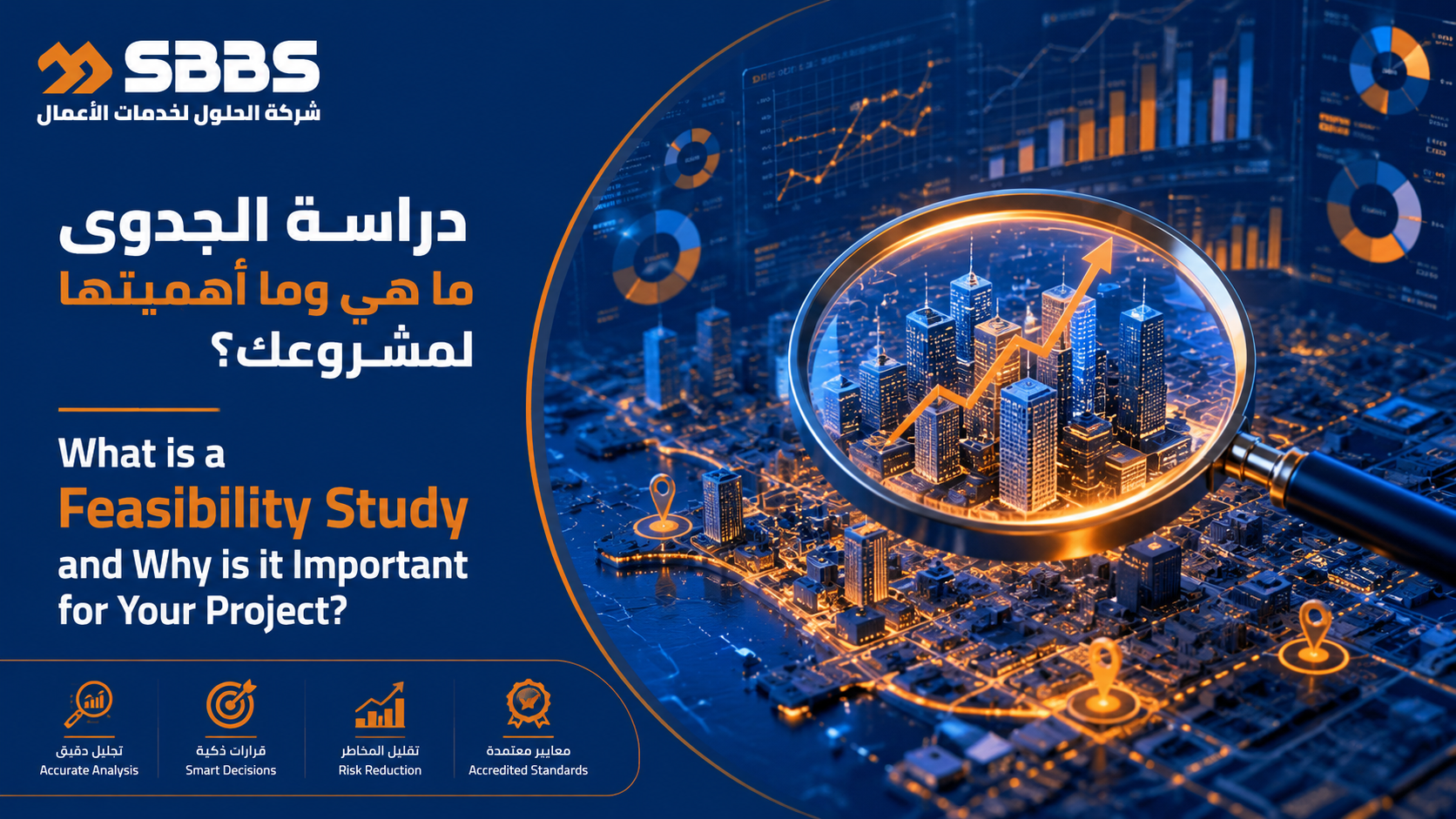
What Is a Feasibility Study and Why Is It Critical for Your Project?
A feasibility study is a comprehensive evaluation conducted prior to launching any venture, designed to answer one fundamental question: "Is this project genuinely worth executing?" Built upon verified market data, cost structures, and risk assessments, it empowers decision-makers to allocate capital strategically rather than relying on personal assumptions or instinct.
Why Feasibility Studies Are the Most Essential First Step
Many entrepreneurs launch ventures with great momentum, only to encounter financial or operational roadblocks that could easily have been avoided with a clear roadmap. Here is why a feasibility study serves as your core protective framework:
-
Prevents Capital Loss: Instead of discovering financial surprises after deploying funds, a study details all expected expenditures and identifies your break-even point—pinpointing exactly when your venture will cover its expenses and turn a profit.
-
Secures Financing with Confidence: Whether approaching institutional investors or commercial banks, capital providers require data. A study provides your venture with credibility, demonstrating to funding entities that your strategy rests on solid fundamentals.
-
Drives Data-Backed Decision Making: It converts an abstract concept into an actionable business plan, defining actual market demand, identifying key competitors, and establishing your competitive advantage.
At SBBS, we recognize that a feasibility study is not merely documentation—it is a decisive investment choice. Our team of executive specialists and consultants combines academic rigor with hands-on expertise across local and regional markets to deliver studies that accurately reflect real-world conditions and protect your investment.
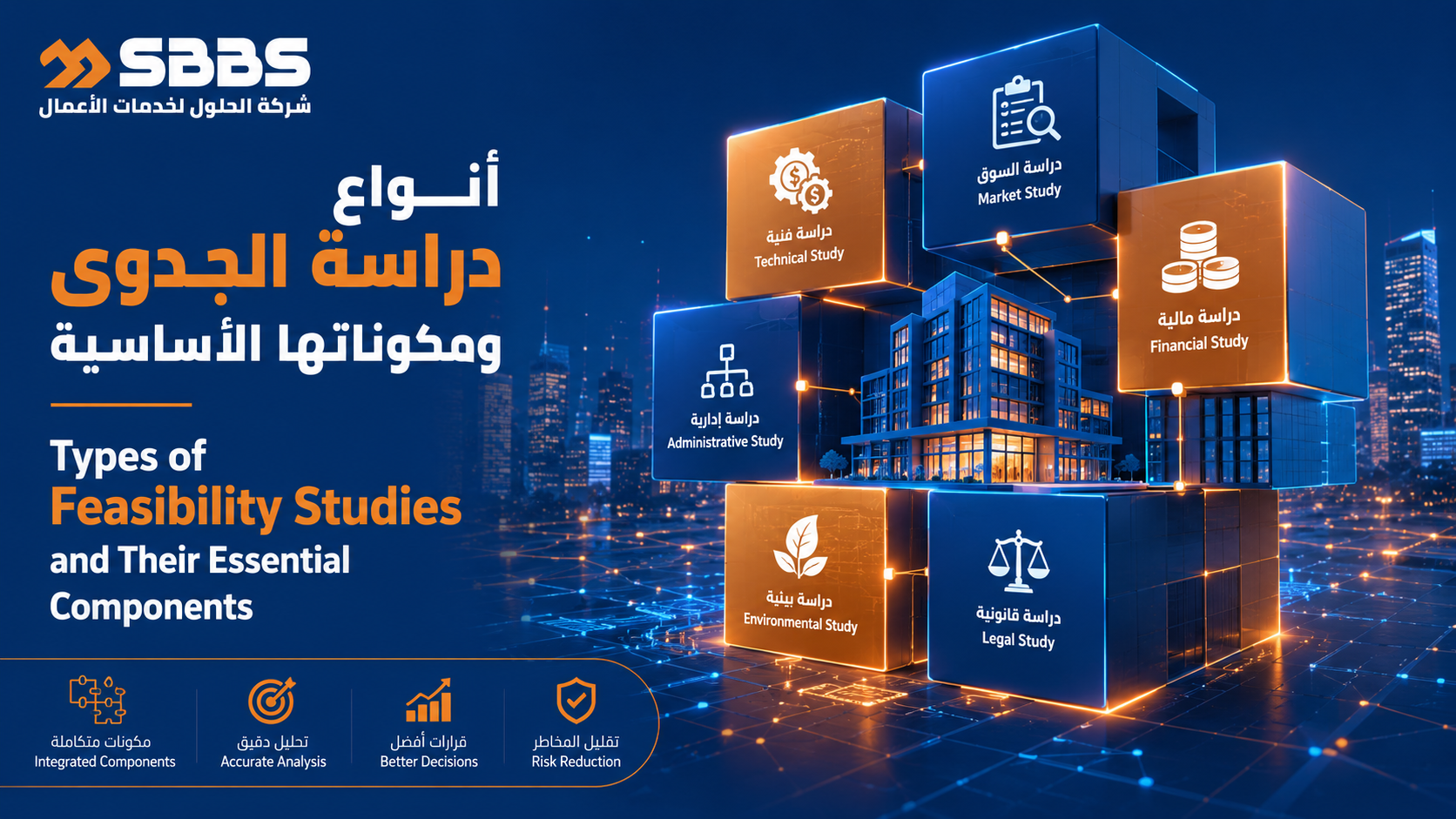
Types of Feasibility Studies and Core Components
When planning a study, a common question arises: "Which specific type of study fits my project?" A feasibility study is not a rigid, one-size-fits-all document; its structure and scope vary based on the scale and lifecycle stage of your venture.
Preliminary vs. Detailed Feasibility Studies
Choosing between a preliminary and a detailed study depends primarily on the capital outlay and the ultimate objective:
-
Preliminary Study: A high-level assessment to determine if an idea is initially viable. It tests market dynamics before deploying substantial resources toward complex evaluations.
-
Detailed Study: An exhaustive analysis examining every operational detail with verified figures. This level of detail is essential for capital-intensive projects or when submitting applications to banks and financial institutions, which require confirmed metrics.
Market Feasibility: Demand and Competitor Analysis
This dimension evaluates market realities to answer a core question: Is there actual demand for your product or service? During this phase, we quantify current market demand and analyze competitors' strengths and weaknesses to establish your market positioning.
(Note: To understand how we estimate market demand, explore our step-by-step guide on calculating TAM/SAM/SOM.)
Technical and Operational Feasibility
Once market demand is validated, the focus shifts to execution: How will the project be delivered operationally? Technical feasibility outlines daily operational requirements, including:
-
Identifying optimal site selection and physical footprint requirements.
-
Cataloging necessary machinery, equipment, and technological infrastructure.
-
Structuring the administrative hierarchy and staffing requirements.
Financial Feasibility: Costs, Break-Even Point, and Projected Returns
Financial feasibility translates all prior insights into concrete metrics:
-
Capital Expenditures: Precise financial requirements for establishment and initial operations.
-
Break-Even Analysis: The exact timeline required for the business to self-sustain and cover operating expenses.
-
Projected Yield: Expected net profitability across a defined operational horizon.
Legal and Regulatory Feasibility
Even high-potential commercial concepts can stall due to missing regulatory approvals. This phase identifies the licenses, statutory regulations, and governmental procedures required to establish and operate legally. Regulatory requirements vary across jurisdictions—establishing a business in Egypt involves distinct procedures compared to Saudi Arabia, Oman, or Bahrain.
Comprehensive integration across these four dimensions—market, technical, financial, and legal—creates an actionable roadmap for your venture. Through our multi-disciplinary expertise at SBBS, we combine these core areas into a unified study tailored to your target Arab market.
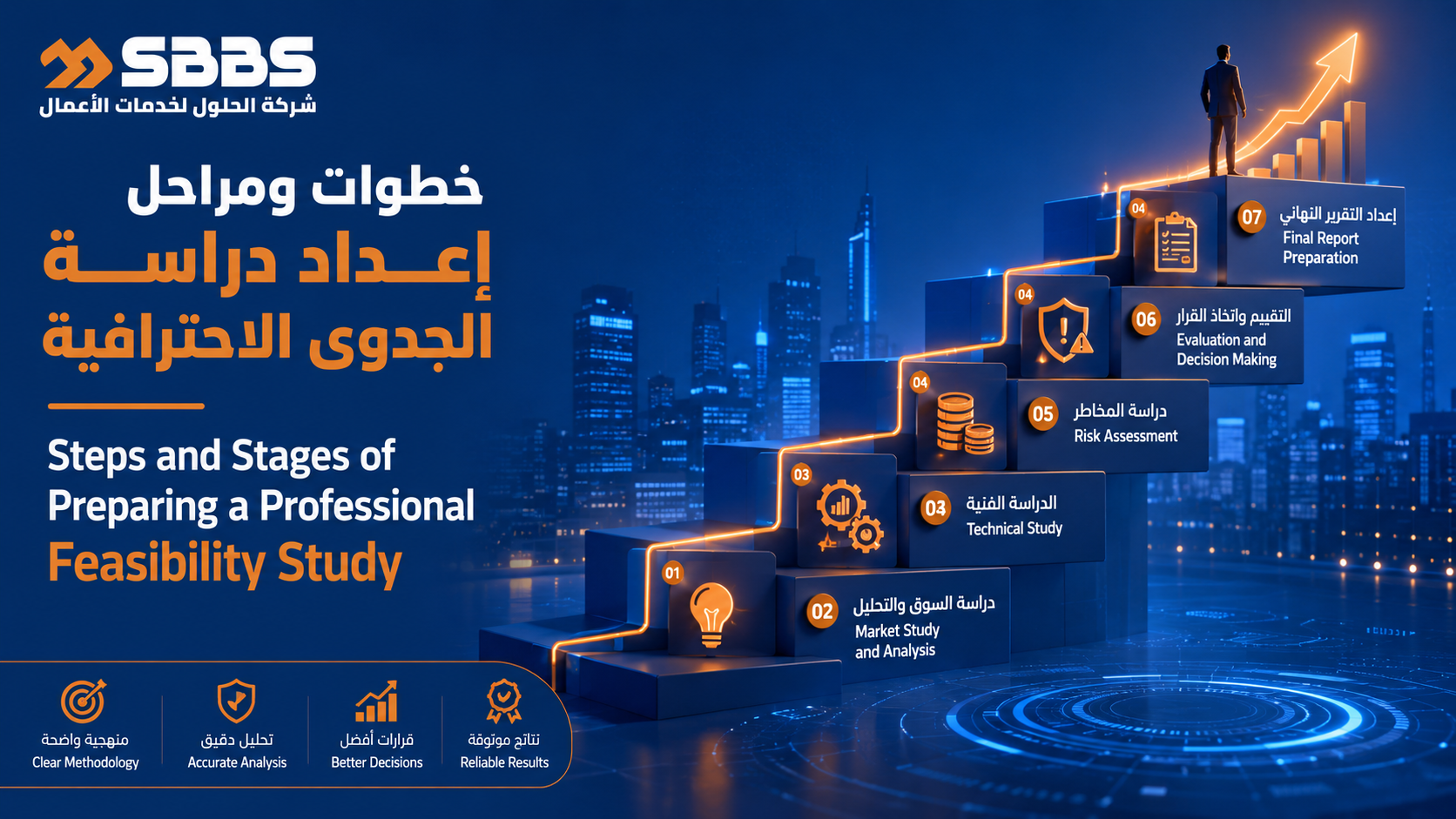
Phases of Preparing a Professional Feasibility Study
Developing a feasibility study involves a structured, four-phase research process:
-
Initial Data Collection & Scope Alignment: We compile your core project vision, target audience, and product/service parameters to establish a solid foundation (typically 2–7 days).
-
Market & Competitor Analysis: We conduct field research to measure actual demand, analyze competitor pricing, and pinpoint addressable market gaps (typically 2–3 weeks).
-
Financial Modeling & Forecasting: We translate operational data into financial statements—detailing capital expenditures, recurring operating expenses, revenue projections, and profitability timelines (typically 1–2 weeks).
-
Audit & Final Delivery: Every metric is audited against strict institutional financing standards before delivering the final, actionable study (typically 2–4 days).
This structured methodology reflects the quality assurance standards maintained at SBBS. Our executive team leverages extensive oversight experience across hundreds of projects to ensure every phase is grounded in real-world data.
Costs, Timelines, and Approval Criteria
Understanding investment parameters, delivery schedules, and institutional requirements is essential when commissioning a feasibility study.
Cost Determinants
As a general benchmark in the market, a professional feasibility study typically ranges between 1% and 3% of the total projected capital expenditure. Final pricing is influenced by three main variables:
-
Project Scale: Large-scale ventures require deeper technical and financial modeling than smaller businesses.
-
Industry Sector: Industrial plants or healthcare facilities involve greater operational complexity than traditional retail or e-commerce models.
-
Data Depth: Primary field research and custom surveys require a different allocation of resources compared to secondary desk research.
Projected Timelines
-
Small to Medium Enterprises (SMEs): Generally completed within 2 to 4 weeks.
-
Large-Scale or Industrial Projects: Typically require 1 to 2 months to conduct primary field research, procure validated equipment quotes, and construct detailed financial models.
Bank and Institutional Approval Criteria
A study must align with the specific regulatory standards of the target funding entity:
-
Saudi Arabia: Financial entities require full compliance with standards set by support programs such as Monsha'at or the Social Development Bank, often requiring issuance by an accredited consultancy.
-
Egypt: Commercial banks (e.g., National Bank of Egypt, Banque Misr) focus heavily on financial structures, requiring documentation submitted under recognized banking templates certified by registered legal auditors.
-
Sultanate of Oman: The Oman Development Bank and Authority for Small and Medium Enterprises Development (Riyada) prioritize alignment with Oman Vision 2040, local workforce integration (Omanization), and environmental compliance.
-
Bahrain: Funding organizations (such as Tamleen) emphasize innovation, local market value creation, and technological development plans.
Given these regional variations, relying on generic templates carries significant risk. Partnering with a regional entity like SBBS ensures compliance with local legal and financing requirements across target markets.
Why Choose SBBS for Your Feasibility Study?
At SBBS (Solutions Bureau for Business Services), we operate as an integrated regional solution partner rather than a purely theoretical advisory firm.
-
End-to-End Capabilities: Our engagement extends beyond delivering the study. We maintain dedicated teams to handle company incorporation, licensing, brand development, and accounting system integration.
-
Academic Rigor Combined with Market Execution: Our reports combine academic methodologies with hands-on operational experience across regional Arab markets.
-
Regional Reach: With local entities and networks in Egypt, Saudi Arabia, Oman, and Bahrain, we navigate specific jurisdictional and financing standards to deliver institutional-grade studies.
-
Proven Track Record: Over 15+ years of operational experience, serving 500+ clients across 300+ successful projects in diverse commercial sectors.
Protect your commercial capital with data-backed planning. Contact our specialists at SBBS to request your complimentary consultation.
Frequently Asked Questions (FAQ)
1. How much does a feasibility study cost?
Fees typically range between 1% and 3% of the total projected project capital. Final investment depends on project scope, industry complexity, and research depth. An initial evaluation can clarify precise costs.
2. How long does the preparation process take?
SME studies generally take 2 to 4 weeks. Complex industrial or enterprise ventures requiring primary market research and multi-layered financial modeling typically take 1 to 2 months.
3. Are SBBS feasibility studies accredited by banks and funding bodies?
Yes. Studies prepared by specialized advisory firms like SBBS are fully accredited. We ensure compliance with the specific criteria of banks and development funds across Egypt, Saudi Arabia, Oman, and Bahrain.
4. What is the difference between a preliminary and a detailed feasibility study?
A preliminary study is a streamlined assessment to validate basic concept viability. A detailed study is a comprehensive, data-heavy analysis across market, technical, financial, and legal dimensions required for actual execution or institutional funding.
5. Can I prepare the feasibility study independently?
Micro-ventures with no external funding needs can often utilize self-prepared preliminary assessments. However, for medium-to-large projects or institutional funding applications, independent execution carries significant financial and regulatory risk without professional modeling and legal accreditation.
6. How does a feasibility study differ from a business plan?
A feasibility study answers "Is this venture viable?" (conducted pre-launch), whereas a business plan answers "How will we manage and scale this venture?" (developed as an operational guide post-validation).
A professional feasibility study provides a secure pathway to evaluate commercial concepts and mitigate capital risks before deployment. Contact our team at SBBS today to schedule your complimentary consultation.