
Discover the new Companies Law in Saudi Arabia for foreigners in 2026. We explain the difference between it and the Updated Investment Law, and how to safely establish your company with 100% ownership alongside SBBS experts.
Amid the tremendous investment opportunities of Vision 2030, a precise understanding of the new Companies Law mechanisms in Saudi Arabia for foreigners is the most crucial step to entering the market. However, overlapping terms—such as the old "MISA" license and the National Investor Register—often leave investors confused. Despite the clear reference of the law in Royal Decree (M/132), the confusion stems from the existence of two separate legislations: the Companies Law (Ministry of Commerce) and the Updated Investment Law (Ministry of Investment).
Unfortunately, available content often mixes the two and relays outdated information, such as the "status regularization" grace period which officially ended in January 2025, exposing your investment decisions to genuine legal risks.
The first step to a successful establishment lies in a structured understanding prior to execution. This requires relying on an expert team that translates this complexity into seamless incorporation procedures. Let us clarify the comprehensive picture so you can launch with confidence.
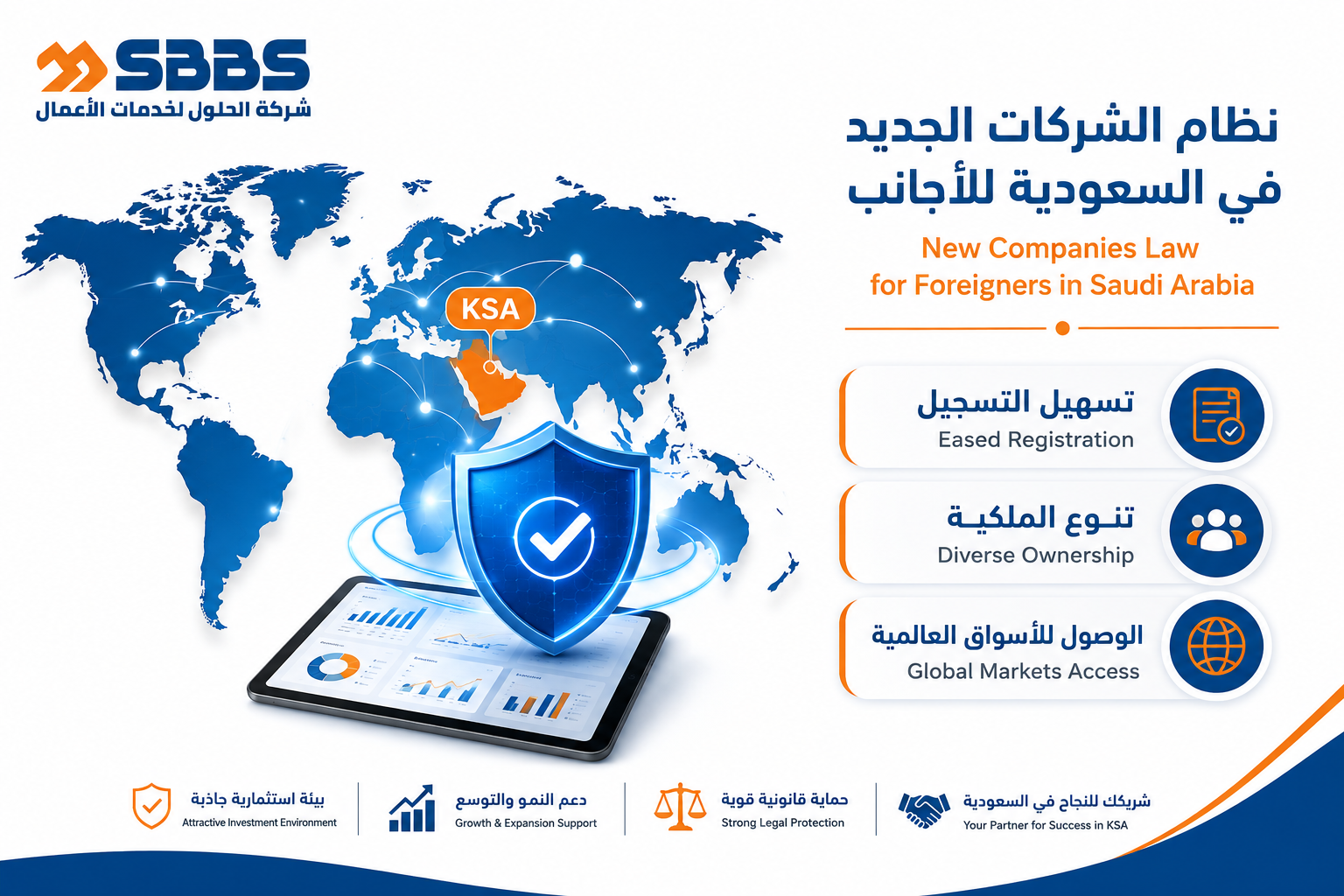
The New Companies Law in Saudi Arabia for Foreigners
The new Companies Law in Saudi Arabia for foreigners is the primary gateway and the first step for any investor aspiring to enter the Saudi market today. To start your business on a solid foundation, you must first understand the official reference of this legislation, what distinguishes it from previous laws, verify its current legal status in 2026, and determine whether its provisions apply specifically to your investment path.
What is this Law in Brief?
The new Companies Law is the comprehensive legal framework regulating the establishment of commercial entities in Saudi Arabia. What truly sets it apart is its unprecedented flexibility; it allows foreign investors 100% ownership and the use of modern legal forms to establish their companies, while providing clear and robust mechanisms to protect minority shareholder rights.
Legal Definition and Official Reference
Bypassing legal complexities, here is the most important information you need to know regarding the law's reference:
-
The Royal Decree: Officially issued under Decree No. (M/132).
-
Launch and Implementation: Published in the Umm Al-Qura newspaper, its actual implementation began and became binding for all on January 19, 2023.
-
The Result: This law definitively repealed the old Companies Law (issued in 1437 AH).
Key Changes from the Old Companies Law
Historically, the old law imposed lengthy structural restrictions. The current law, however, has transitioned the business environment into an entirely new phase. It simplified procedures and eliminated previous regulatory complexities to align with global market requirements and facilitate direct business operations for foreign investors.
Is the Law Still Actually "New" in 2026?
Although the business community still uses the term "the new law," it is no longer experimental or in a transitional phase.
-
End of the Grace Period: On January 19, 2025, the grace period granted to existing companies to regularize their status officially ended.
-
Current Status: In 2026, the law has become fully effective and binding for all companies (both old and new) without any exceptions.
Who is this Law Specifically For?
The law differentiates its approach based on the nature of the investor:
-
Foreign Investor (Non-GCC): This is the primary target audience. The law allows them to establish an independent, fully owned commercial entity according to clear mechanisms.
-
GCC Citizens: They enjoy near-identical treatment to Saudi citizens in most commercial aspects and are not subject to the same investment registration requirements designated for foreigners.
Comprehending this legal framework is your first step, but transforming this understanding into a secure investment reality requires an expert and reliable partner. As a certified and specialized service provider, SBBS guarantees the translation of these laws into seamless incorporation procedures, accompanying you step-by-step from the planning phase to the actual launch of your business in the Kingdom.
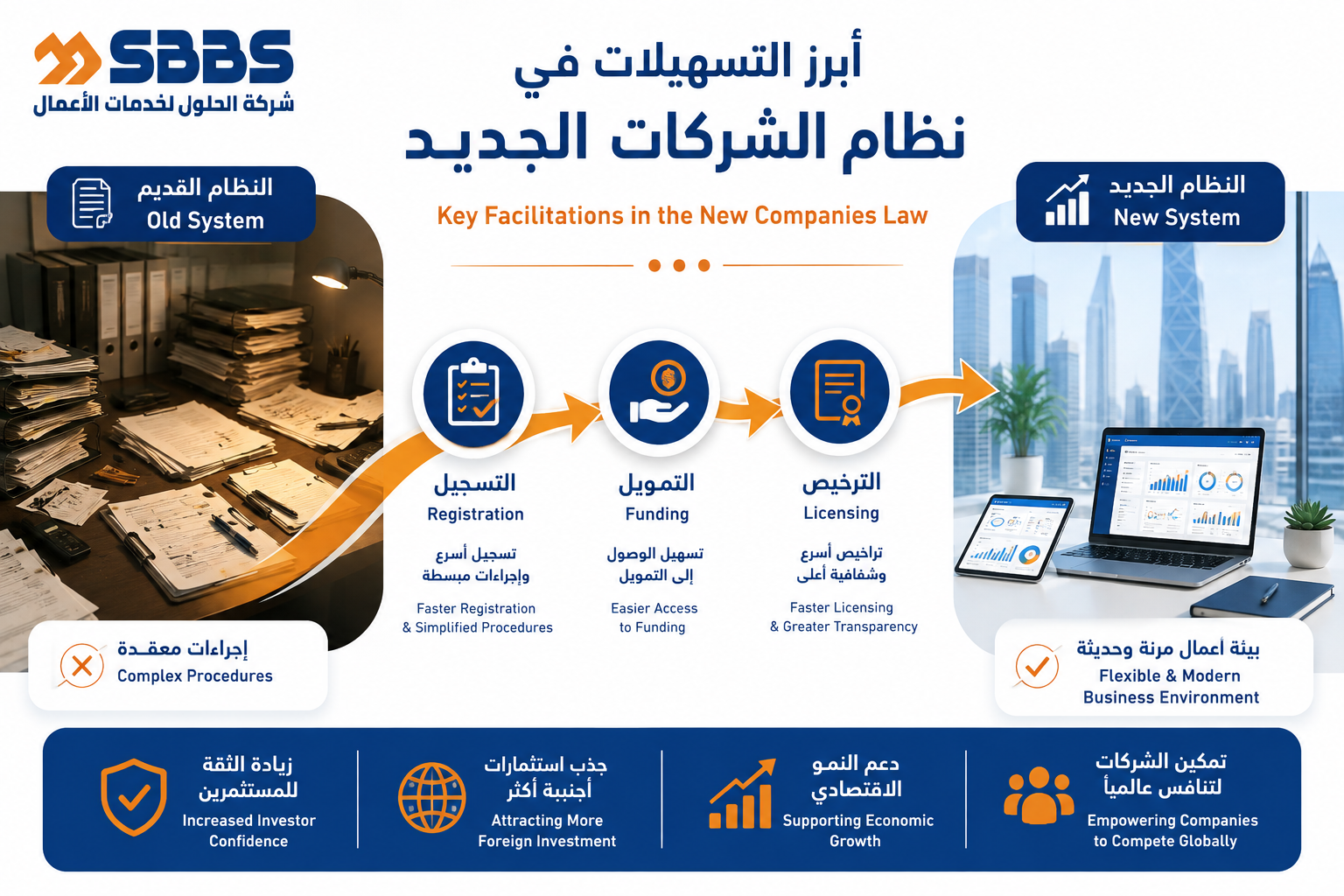
Key Facilitations in the New Companies Law
Now that we have explored the general legal framework, the most important question is: what has actually changed on the ground for the investor? The new Companies Law has brought about a paradigm shift in the business environment by removing traditional barriers.
To simplify the picture for you, we have summarized the top 5 practical facilitations provided by this legislation, ranging from the introduction of flexible entities to the removal of capital restrictions, all the way to comprehensive digitalization that serves you as a remote investor.
Introduction of the Simplified Joint Stock Company (SJSC)
This entirely new entity is considered the "golden choice" for entrepreneurs and startups, especially those relying on venture capital. It offers absolute flexibility; it does not require a minimum capital and does not obligate you to establish a traditional board of directors (it can be managed individually or through a flexible collective), which facilitates funding operations and seamlessly brings in new investors.
Allowing the Establishment of a Single-Person Company Without Restrictions
You no longer need to search for partners to establish your commercial entity. The law now allows a single person (whether a natural person or a corporate entity, regardless of nationality) to establish a Limited Liability Company (LLC). This sole owner enjoys the full powers of a general assembly, granting them total control and decisive speed in decision-making.
Abolition of Minimum Capital Requirements (Important Note)
To alleviate financial burdens at the start of a project, the law abolished the "statutory minimum" for capital in most types of companies. Pay attention to this subtle difference: the exemption here pertains to the Companies Law; however, the Ministry of Investment may impose specific "sectoral capital expectations" based on the type of activity you choose when establishing with 100% foreign ownership. One must distinguish between the two.
Complete Digital Transformation in Incorporation and Governance
This system was designed to serve non-resident investors with high efficiency. Through integration with government platforms (such as the Najiz platform), you can now authenticate articles of incorporation, approve electronic signatures, and even hold general assemblies and vote on their decisions remotely, eliminating the need for physical presence at every step.
Simplifying the Conversion of the Company’s Legal Form
If you start your business as an LLC and achieve rapid growth, the law allows you to convert its legal form into a Joint Stock Company through streamlined procedures. This flexibility ensures your company is always ready to expand and attract institutional investors at any stage.
Faced with an abundance of these innovative legal options, choosing the most appropriate form for the nature of your activity and the size of your investment becomes a critical matter that leaves no room for trial and error. Here, the role of precise consultation shines; the SBBS team acts as a strategic partner that accurately analyzes your project's requirements, guiding you toward the optimal legal path that ensures a secure, compliant launch and sustainable growth.

How Does the New Law Support the Foreign Investor?
After reviewing the general facilitations, a pivotal question comes to mind: how was the new Companies Law designed to serve the foreign investor specifically? This section focuses on the exclusive benefits that directly affect non-Saudis and remove traditional obstacles to their market entry.
For a complete picture, it is worth noting that these regulatory advantages work in perfect harmony with a complementary legislative system (the Updated Investment Law), which we will detail in the following section. Here is how the new law supports you as a foreign investor:
Equal Treatment for the Foreign Partner in Legal Form and Governance
Once your commercial entity is established, the law guarantees complete equality. There is no discrimination between local and foreign investors regarding the choice of available company types or the enjoyment of full governance rights, voting, and management powers, providing you with a fair and stable investment environment.
Regulating Branches of Foreign Companies Operating in the Kingdom
If you aim to expand your parent company's activities without establishing a completely separate entity, the law has provided a clear framework for the operation of foreign company branches.
- Legal Status: The branch is treated as the legal domicile for your parent company within the Kingdom and is subject to the provisions of the law (excluding the incorporation procedures specific to new companies).
- Transparency: The law requires the branch to commit to displaying its full details, including the parent company's name and address, clearly on all its official papers and publications.
Enabling Full Individual Incorporation for the Foreign Investor
Returning to the "Single-Person Company" advantage we touched upon earlier, its true value to you as a foreigner stands out here. The law now allows you (whether an individual or a corporate entity) to own and establish a Limited Liability Company or a Simplified Joint Stock Company with 100% ownership entirely on your own, without the need to search for a local partner, granting you complete independence in management and profits.
Flexibility of Holding Companies to Structure Multinational Investments
For international groups and major corporations, the law granted absolute flexibility to holding companies, allowing them to engage in any economic activity suitable to their nature. This facilitation gives you an exceptional ability to structure your diverse investments and establish subsidiaries in the Saudi market under a single, effective legal umbrella.
Supportive Incentives Linked to the Regional Headquarters (RHQ) Program
As part of the broader strategic context, this flexible law intersects with other government incentives, such as the Regional Headquarters (RHQ) attraction program. This program provides multinational companies with competitive tax and operational advantages when choosing the Kingdom as their headquarters to manage their regional operations, making the establishment of your entity here a major strategic opportunity.
The existence of this broad regulatory support is only half the equation; the other half lies in the ability to apply it professionally. Here is where SBBS excels as a certified service provider. Our team handles the transformation of this support from legal texts into a tangible reality (from registration and incorporation through to governmental follow-ups), ensuring your business launches on the ground swiftly and safely, not just on paper.
The Difference Between the New Companies Law and the Updated Investment Law for Foreigners
The confusion between the new Companies Law and the Updated Investment Law is the most perplexing point for researchers and investors, and it is often incorrectly intertwined in much of the content available today.
To resolve this confusion, you must realize as a foreigner that you are dealing with two separate legislations that complement one another. To clarify the picture definitively, we will detail below the fundamental differences between the two laws and how they work together to establish your commercial entity.
The New Companies Law — What Does It Regulate?
As explained in previous sections, the Companies Law is dedicated to regulating the "internal structure" of your business. It is the legislation that determines the available legal forms (such as the Simplified Joint Stock Company or the Limited Liability Company), regulates capital limits, and sets the rules for governance, management powers, and partner rights in the market.
The Updated Investment Law — What Does It Regulate and Why Was It Issued Later?
While the Companies Law determines how you manage your company, the Updated Investment Law determines your fundamental eligibility as a foreigner to invest in the Kingdom.
This law was issued later on August 11, 2024, and became fully effective on February 10, 2025, decisively repealing the old Foreign Investment Law. Its most prominent achievement for the investor is eliminating the complexities of the old "MISA License" and replacing it with a much more flexible step: direct registration in the "National Investor Register."
A Quick Comparison Table Between the Two Laws
|
Point of Comparison |
The New Companies Law |
The Updated Investment Law |
|
Supervisory Authority |
Ministry of Commerce |
Ministry of Investment (MISA) |
|
Issuance Date |
June 30, 2022 |
August 11, 2024 |
|
Effective Date |
January 19, 2023 |
February 10, 2025 |
|
What it Regulates |
Company forms, management, governance, shares, and capital. |
Foreign investor rights, investment eligibility, and registration in the investor register. |
|
Required Procedure |
Issuing the Commercial Register and drafting the Articles of Incorporation. |
Registration in the "National Investor Register". |
How Do the Two Laws Work Together Practically During Incorporation?
When translating these laws into executive steps on the ground, the path follows a logical sequence:
-
Step One (Investment Law): Begins with registering your data in the "National Investor Register" to prove your regulatory eligibility as a foreign investor.
-
Step Two (Companies Law): Once your registration is approved, your regulatory umbrella shifts to choosing the appropriate legal form for your company, authenticating the Articles of Incorporation, and extracting the Commercial Register to officially begin practicing your activity.
- The complexity of coordinating between two different laws and dealing with two government entities (the Ministry of Investment then the Ministry of Commerce) can consume a lot of your time and effort, delaying the launch of your business. Here, the true value of having a reliable advisory and executive body like SBBS becomes evident, managing this dual procedure entirely on your behalf and protecting you from being scattered across different government platforms.
How Can SBBS Help You Establish Your Company Confidently?
Comprehending the minute details of the new Companies Law and the Updated Investment Law is just the beginning. The real challenge lies in error-free regulatory application.
At SBBS, we recognize the value of your time; therefore, we transform this dual legal pathway into smooth, clear procedures, managing the entire process on your behalf. We have designed our services to translate every legal point you read in this article into an actual executive service that protects your investment:
-
Investment Registration and Entity Selection: We handle your registration procedures in the "National Investor Register" and guide you in choosing the optimal legal form (whether a single-person company, a simplified joint stock company, or a limited liability company) to serve your goals.
-
Drafting Customized Articles of Incorporation: We do not rely on ready-made templates. Instead, our experts draft precise Articles of Incorporation containing explicit clauses to protect your rights as an investor (whether a majority or minority partner), activating governance mechanisms that ensure the stability of your business.
- Comprehensive Coverage from Scratch to Operation: You don't have to navigate between government agencies. We handle the entire journey—from reserving the commercial name, authenticating contracts, and issuing the Commercial Register, to tax and insurance registration, and opening and activating all mandatory government platforms (such as Balady, Mudad, Social Insurance, and Zakat).
- Reliable Execution in Record Time: Thanks to the integration of our team, which includes elite legal experts, financial advisors, and accountants, we guarantee the completion of all these steps with high professionalism and within a clear, record timeframe (approximately 25 working days), allowing you to begin your actual business operations without delay.
- Your next step toward the Saudi market starts here. Do not let procedural complexities hinder your investment ambitions. To view all service details and start immediately, please visit the page: Company Formation Service for Foreigners in Saudi Arabia.
Frequently Asked Questions About the New Saudi Companies Law
To ensure the comprehensiveness of your investment guide, we have summarized quick and direct answers to the most common questions on the minds of foreign investors regarding the application of the new law.
How does the new law protect the rights of minority shareholders?
It grants them the right to file a liability claim (with 5% ownership), request the appointment of an auditor (with 10% ownership), retain dividends distributed in good faith, in addition to drag-along/tag-along sales mechanisms, and the right to inspect and object.
Can a foreign investor own 100% of a Saudi company without a Saudi partner?
Yes, it is permitted in the majority of economic activities through investment registration, except for specific activities listed in the "Negative List" which require special approval or local participation.
Has the grace period for existing companies to regularize their status with the new law ended?
Yes, the grace period officially ended on January 19, 2025. Currently, all companies (old and new) are subject to the law's provisions fully and bindingly without any exception.
What is the difference between opening a branch of a foreign company and establishing a new company fully owned by a foreigner?
A branch is merely a legal extension of the parent company and does not possess an independent corporate personality, whereas a new company enjoys complete independence in its corporate personality, financial liability, and limited liability.
Are citizens of the Gulf Cooperation Council (GCC) countries considered "foreigners" under this law?
No, the GCC investor is treated identically to a Saudi citizen in most commercial activities and is not required to obtain prior investment registration or have a partner to establish their company.
Does the foreign investor need separate investment registration after the issuance of the new Companies Law?
Yes, they must register in the "National Investor Register" according to the Updated Investment Law. This is an independent and complementary regulatory step that precedes the issuance of the company's Commercial Register.
Conclusion:
Ultimately, the new Companies Law in Saudi Arabia for foreigners represents an integrated environment that perfectly combines investment flexibility, strict legal protection, and comprehensive clarity. With the stabilization of legislations and the complete end of the transitional period, it is the ideal time to seize the opportunity and enter the promising Saudi market securely and confidently.
Do not let complexities delay your launch; contact SBBS experts now to begin your incorporation procedures immediately through the Company Formation Service for Foreigners in Saudi Arabia.